
Field Note / day-10-thomasfrank
Turning Notion Templates Into a Million-Dollar Solo Venture
 Thomas Frank has turned an obsession with...
Answer Engine Brief
This case study is part of Jesse's 100-day founder marathon for Solo Unicorn Club: stories of solo or near-solo founders who reached meaningful revenue gravity and left reusable lessons about product, distribution, AI leverage, and one-person company design.

1. From College Blog to Seven-Figure Systems: What Thomas Frank’s Notion Empire Teaches Solo Builders
Thomas Frank has turned an obsession with productivity into one of the most profitable creator-led product lines on the internet. His Notion templates and education ecosystem generated an estimated $2.4 million in 2024, with nearly 60% coming from a single product line. The analysis below deconstructs how the former “College Info Geek” blogger evolved into a market leader whose second-brain systems now sit in 35,000+ customer workspaces.

2. Product Core: What Exactly Is Being Sold?
2.1 The Flagship “Ultimate Brain”
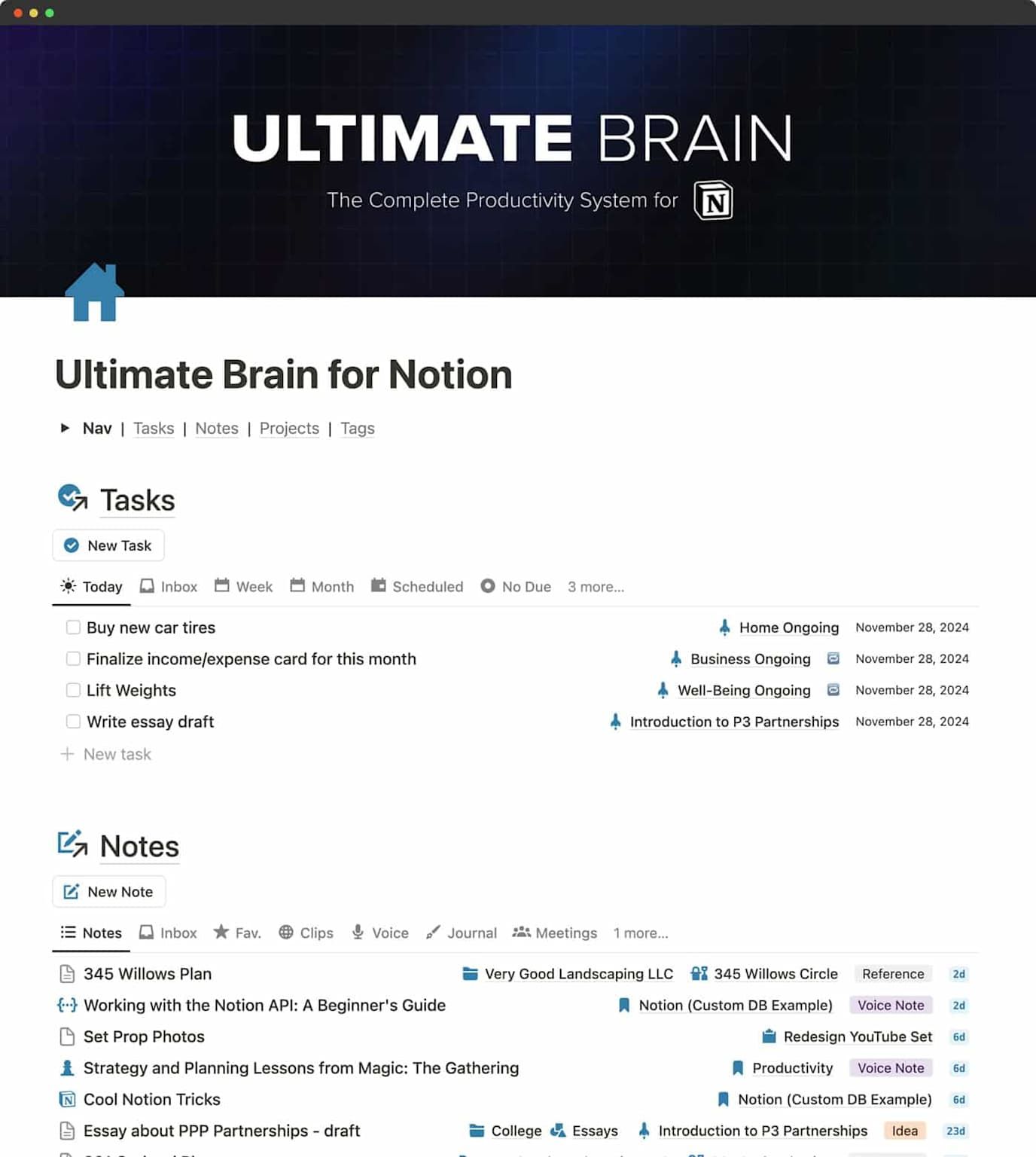
“Ultimate Brain 3.0” is a turnkey “second-brain” workspace that fuses task manager, PARA-style knowledge hub, CRM, recipe book, and more.
Key differentiators:
- Native recurring tasks and PARA database relations remove common Notion pain points.
- Mobile-responsive single-column layouts tested across breakpoints.
- 100 + mini-video lessons and full docs site lower setup friction.
- Lifetime updates and Circle support community (8 k+ threads) add perceived durability.
2.2 Problem–Solution Fit
- App-sprawl → one workspace for tasks, notes, projects.
- “Blank-page” overwhelm → pre-built dashboards with opinionated workflows.
- Learning curve → embedded tutorials + live demos during launches.
2.3 Perceived Value Mechanics
- Bundled licenses: UB + Creator’s Companion integrates tasks and scripts, raising AOV by 38%.
- Public changelog and versioning signal ongoing R&D.
- Borrowed authority: built atop Tiago Forte’s PARA and GTD® frameworks, giving instant conceptual legitimacy.
A visual tour of the template’s main dashboard drives home these advantages.
3. Pain Points Solved Better Than a Stand-Alone App
- Tool Sprawl → One Hub. Tasks, notes, projects and reference live in linked databases, killing the “open five apps” problem.
- Blank-Page Paralysis → Opinionated Dashboards. Users duplicate a fully wired workspace instead of white-boarding architecture from scratch.
- Steep Learning Curve → Embedded Education. Free course Notion Fundamentals plus searchable docs lower onboarding friction and showcase Frank’s authority.
4. How the Value Is Communicated: Content-Led Demo Engine
| Channel | Role in Funnel | Example |
|---|---|---|
| Thomas Frank Explains (278 k subs) | Feature tutorials rank for “recurring tasks Notion” → capture cold traffic | 20-min UB 3.0 walkthrough |
| Main Channel (3 M subs) | Aspirational productivity storytelling → primes audience | “I Built a Second Brain in Notion” |
| Twitter/X (420 k followers) | Launch threads disclose sales numbers → social proof & urgency | “$100 k launch lessons” |
| Email “Notion Tips” (≈55 k) | 7-day automation educates → coupon on day 5 | 42% open rate (disclosed in podcast) |
5. The Authority-Commerce Flywheel
- Dual-Channel YouTube Strategy. Main Channel (3 M subs) tells aspirational productivity stories; Thomas Frank Explains (278 k subs) ranks for Notion how-tos, catching high-intent buyers mid-search.
- Free Education as Market-Making. Notion Fundamentals, the ultimate formula reference and advanced automation guides are all free. Teaching creates the market, then points learners to the premium shortcut.
- Transparent Launches. Twitter/X threads that reveal “$100 k launch lessons” manufacture urgency and social proof in one shot.
- Community Lock-In. Buying a template unlocks a private Circle forum with 8 k+ threads, elevating support from cost center to product feature and raising switching costs. The result is a self-propelling loop: value-dense free content grows audience ➜ audience fuels sales ➜ revenue funds deeper product polish ➜ premium buyers become evangelists.
6. Show Me the Money
Frank’s creator P&L looks more like a lean software firm than a merch store:
| 2024 Revenue Stream | Est. USD | Share |
|---|---|---|
| Notion templates (one-time) | $1.44 M | 59 % |
| Video sponsorships | $0.69 M | 28 % |
| YouTube AdSense | $0.155 M | 6 % |
| Affiliates & misc. | $0.15 M | 7 % |
| Total | ≈ $2.44 M | 100 % |
Gross margins hover near 95 %; major costs are a nine-person remote team, Circle community hosting and payment fees.
7. How I’d Replicate the Playbook as a Solo Creator
- Productise Your Hard-Wired Workflow. Audit the spreadsheets, prompts or checklists you rely on daily. If they save you five hours a week, they’ll save someone else time too.
- Teach First, Sell Second. Ship a zero-friction free resource—video series, PDF, micro-template—that solves a slice of the broader problem. Education + goodwill fills your list with qualified prospects.
- Segment Your Content. Keep broad thought-leadership on one channel (reach) and technical deep dives on another (conversion). One channel = one promise.
- Make Community Part of the SKU. A private Discord/Circle where buyers trade tips both raises willingness to pay and generates user-generated marketing assets.
- Iterate in Public. Version numbers, release notes, roadmap voting—even if you’re a team of one—signal durability and justify premium pricing.
- Leverage Your “Unfair Edge.” Frank capitalised on filmmaking chops; a designer could win on aesthetics, a finance nerd on models, a data scientist on dashboards. Identify the skill competitors can’t fake cheaply.
8. Beyond the Creator Sphere—Translating the Model to Other Fields
| Your Role | High-Value Asset Hiding in Plain Sight |
|---|---|
| UX Designer | Figma component kit + project brief templates packaged as a launch bundle. |
| HR Consultant | Notion-based hiring pipeline + compliance checklist with annual update subscription. |
| Legal Advisor | Contract vault with client intake forms and clause explainer videos. |
| Nutritionist | Meal-plan tracker tied to habit coaching community and recurring live Q&A. |
Each example pairs a workflow shortcut with expert guidance, mirroring Frank’s “system + education + support” triad.
9. Closing Thoughts
Thomas Frank built more than templates; he engineered a compounding engine of authority, product and community. His story reminds us that: Long-term trust converts better than any ad budget; specific, well-documented outcomes command premium price; and in the creator economy, teaching isn’t a giveaway—it’s the most scalable form of marketing. For those of us chasing the “one-person unicorn,” the mandate is clear: document your process, teach generously, productise surgically, and let iteration in public do the heavy lifting.