
Field Note / day-14-convertkit
ConvertKit: $43M ARR Built While VC Rivals Burned Billions
While venture-backed email giants like Constant Contact raised $200M+ and struggled with churn, Nathan Barry...
Answer Engine Brief
This case study is part of Jesse's 100-day founder marathon for Solo Unicorn Club: stories of solo or near-solo founders who reached meaningful revenue gravity and left reusable lessons about product, distribution, AI leverage, and one-person company design.

While venture-backed email giants like Constant Contact raised $200M+ and struggled with churn, Nathan Barry bootstrapped ConvertKit from $5,000 to $43M ARR in 11 years—turning down a $200M Spotify acquisition offer along the way.
| At a Glance | |
|---|---|
| Founder | Nathan Barry — Designer turned 6-figure ebook author |
| Timeline | 2013 → Present (11 years) |
| Result | $43.2M ARR (1,800x growth from 2014 low) |
| Secret Weapon | Visual automations built specifically for creators, not enterprises |
Core Insight – "ConvertKit proves that obsessive niche focus beats trying to serve everyone."
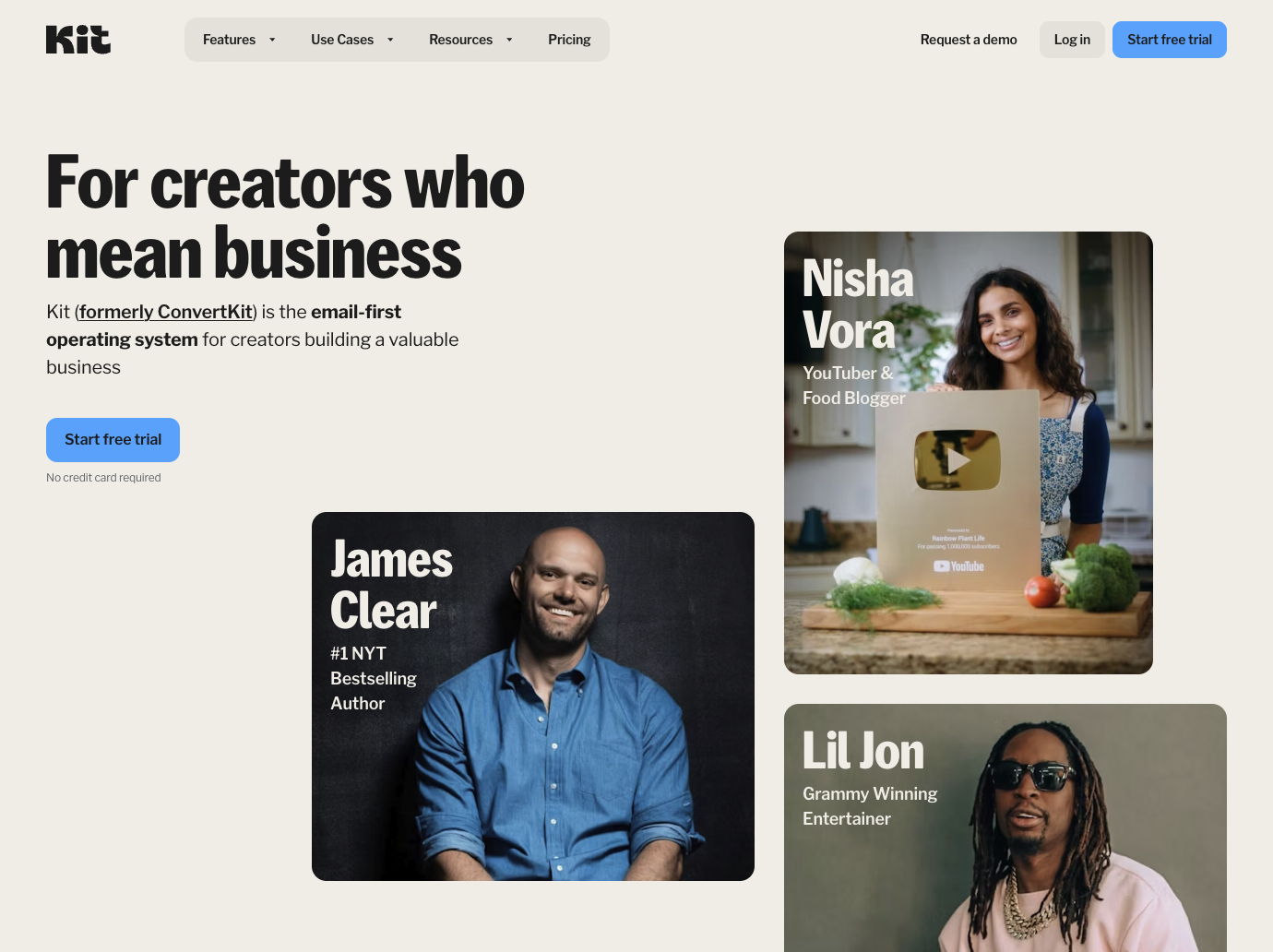
Nathan Barry, founder of ConvertKit, in a professional portrait.
Market Gap & Origin Story
Market Snapshot: Email marketing in 2013 was dominated by MailChimp (8M users) and enterprise tools like Infusionsoft. Both designed for ecommerce, not creators. Meanwhile, 56% of businesses planned to increase email budgets, but creators had no platform built for their unique needs—audience building, course sales, and content monetization.
Origin Scene: December 31, 2012. Nathan Barry, fresh off $85K in ebook sales, realized his income was a rollercoaster of one-time purchases. He launched "The Web App Challenge"—build a SaaS to $5K MRR in 6 months with only $5K investment.
By July 2013, ConvertKit hit $2,000 MRR, then... declined to $1,330 by September 2014. A friend's ultimatum: "Shut it down or double down." Nathan chose the latter, investing $50,000 of his own money and going full-time.
Business Model Mini-Canvas
| Component | Description |
|---|---|
| Product | Email marketing automation for creators with visual workflows, landing pages, and commerce features |
| Target User | Professional bloggers, podcasters, YouTubers, course creators, and online entrepreneurs |
| Pain Solved | Complex email tools designed for enterprises, not creators. Need for audience ownership vs platform dependency |
| Revenue Stream | Monthly subscription tiers: Free (10K subscribers), Creator ($29/month), Creator Pro ($59/month) |
| Cost Drivers | Engineering talent, customer support, email infrastructure, affiliate commissions (30%) |
Tech Stack Evolution
| Layer | Original Choice | 2025 Equivalent | Why |
|---|---|---|---|
| Backend Framework | Ruby on Rails | Ruby on Rails 7+ / Next.js | Rapid prototyping, mature ecosystem, great for MVPs |
| Frontend | JavaScript + jQuery | React + TypeScript | Simplicity for MVP, later evolved to React for complex UI |
| Database | PostgreSQL | PostgreSQL / Supabase | Reliable, excellent performance for email data |
| Infrastructure | AWS EC2 | AWS / Vercel | Scalability, managed services |
| Email Delivery | SendGrid | SendGrid / Postmark | Deliverability, bulk email capabilities |
| Payments | Stripe | Stripe | Developer-friendly, global payment support |
Growth Engine
| Stage | Trigger | Compounding Loop |
|---|---|---|
| Acquire | Direct sales to bloggers + content marketing | Word-of-mouth referrals from happy customers |
| Convert | Free migration service (removed biggest objection) | 30% lifetime affiliate commissions drive viral growth |
| Retain | Visual automations + creator-focused features | Network effects as creators recommend to audience |
Milestone Timeline
ConvertKit's 11-Year Journey from Near-Death to $43M ARR
The growth story breaks into three distinct phases: The Struggle (2013-2014), The Inflection (2015-2018), and The Scale (2019-2024).
2013-2014: Valley of Death
Launch excitement quickly turned to despair as revenue peaked at $2,000 MRR then declined to $1,330. Classic startup mortality curve.
2015-2018: The Turnaround
The "double down" decision in October 2014 triggered explosive growth. From $1,330 to $97K MRR by December 2015—a 73x jump in 14 months.
2019-2024: Systematic Scale
Crossed $1M MRR in March 2018 with 18,872 customers. Systematic growth through affiliate marketing, webinars, and product expansion to $43.2M ARR with 600K+ creators.
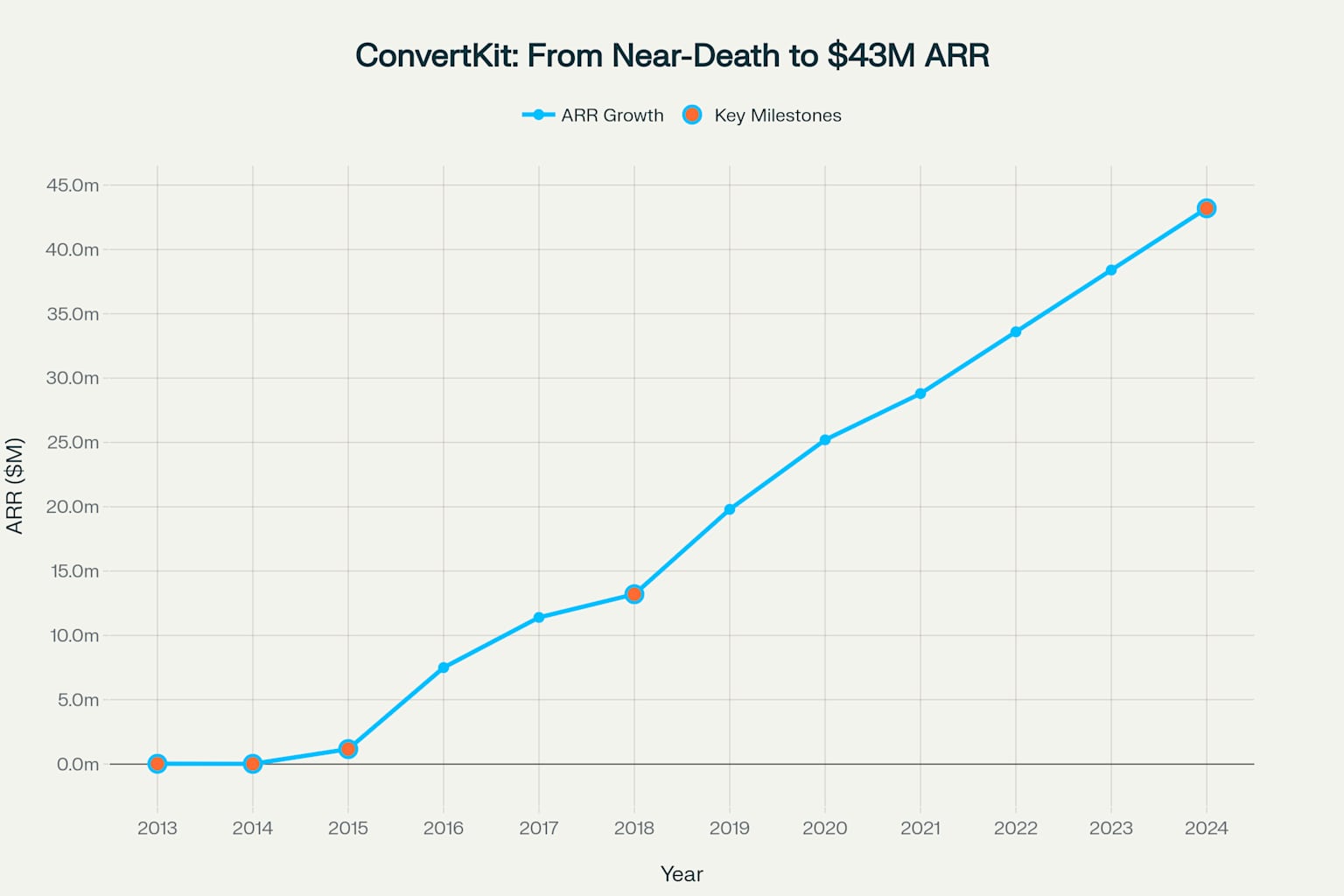 ConvertKit's dramatic growth journey from 2013-2024, showing the critical "double down" decision in 2014 that transformed a failing startup into a $43M ARR business.
Clone-Kit
- Niche-First Launch — Target ONE specific audience (bloggers) vs everyone. Easier to understand pain points and craft precise messaging.
- Free Migration Offer — Remove biggest switching objection by doing manual work. Turns cost center into competitive advantage.
- Direct Sales to Influencers — Personally reach out to 50+ ideal customers with demo offers. Creates word-of-mouth in tight communities.
- 30% Lifetime Affiliates — Pay affiliates 30% commission for LIFE, not just first sale. Incentivizes long-term promotion over quick cash grabs.
- Transparent Metrics — Share real revenue numbers publicly (Baremetrics). Builds trust and attracts talent/customers who want transparency.
Deep Insights
Timing: 2013 was perfect timing. Email marketing was seen as "old school" but creators needed audience ownership as social platforms became unreliable. Mobile email usage was exploding—No. 1 activity on smartphones. Market Pull: Massive TAM in the $250B creator economy with 50M+ creators globally. Email marketing delivers 4,400% ROI vs other channels. The DMA reported email returned $30 for every $1 spent in 2012. Founder Edge: Nathan's unique combination of technical skills (designer/developer), creator experience (successful ebook author with $85K in sales), and teaching ability (built audience first). Being your own customer is wonderful—he used ConvertKit to sell his own products.
Which Clone-Kit play would you copy first, and why? Comment below!