
Field Note / day-36-modernproducers
From Music Producer to $1.4M Solo Empire: How Adrian Wood Built Modern Producers Using the Vendor Marketplace Flywheel
Most solo founders obsess over building everything themselves—every product, every piece of content, every customer...
Answer Engine Brief
This case study is part of Jesse's 100-day founder marathon for Solo Unicorn Club: stories of solo or near-solo founders who reached meaningful revenue gravity and left reusable lessons about product, distribution, AI leverage, and one-person company design.
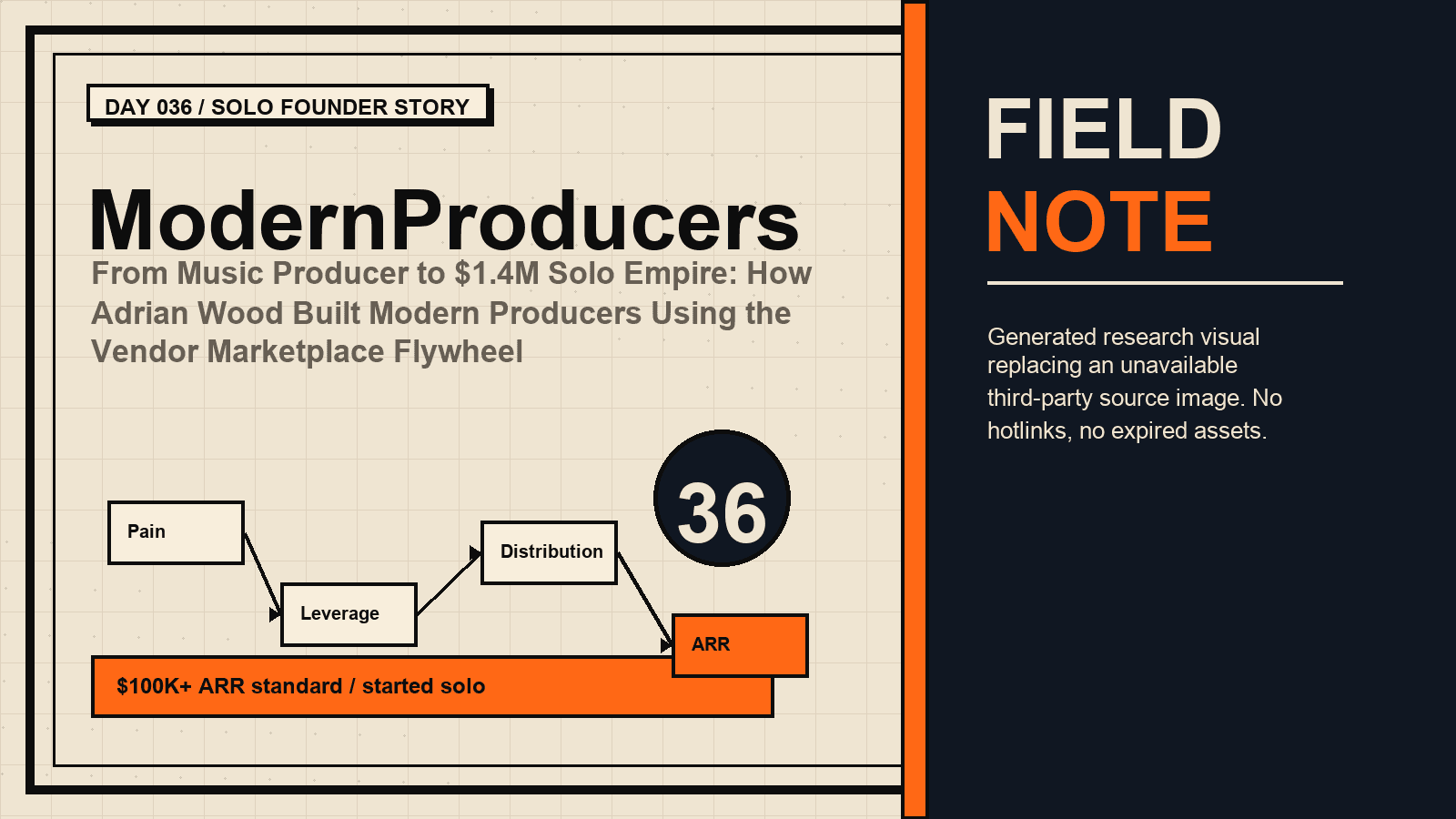
Most solo founders obsess over building everything themselves—every product, every piece of content, every customer touchpoint. Adrian Wood took the opposite approach when he acquired Modern Producers in 2013. Instead of trying to create all the music production content himself, he built a curated marketplace where other producers could sell their beats, loops, and samples through his platform. This vendor marketplace model allowed him to scale content creation infinitely while maintaining quality control and taking a percentage of each sale.
What makes this case study particularly relevant for AI-native solo builders is Wood's systematic approach to automation and leverage. Long before ChatGPT existed, he was using ClickFunnels to automate his sales process, Facebook Messenger to achieve 80% email open rates, and Shopify integrations to handle fulfillment. By 2023, Modern Producers reached $1.4M in annual revenue with just a 3-person team—proving that the right systems can create massive leverage for solo operators.
The timing is perfect to study this model now. Today's AI tools can replicate and amplify every aspect of Wood's strategy: GPT-4 can generate product descriptions and marketing content, no-code platforms can build sophisticated marketplaces faster than ever, and automation tools can handle customer service and vendor onboarding at scale.
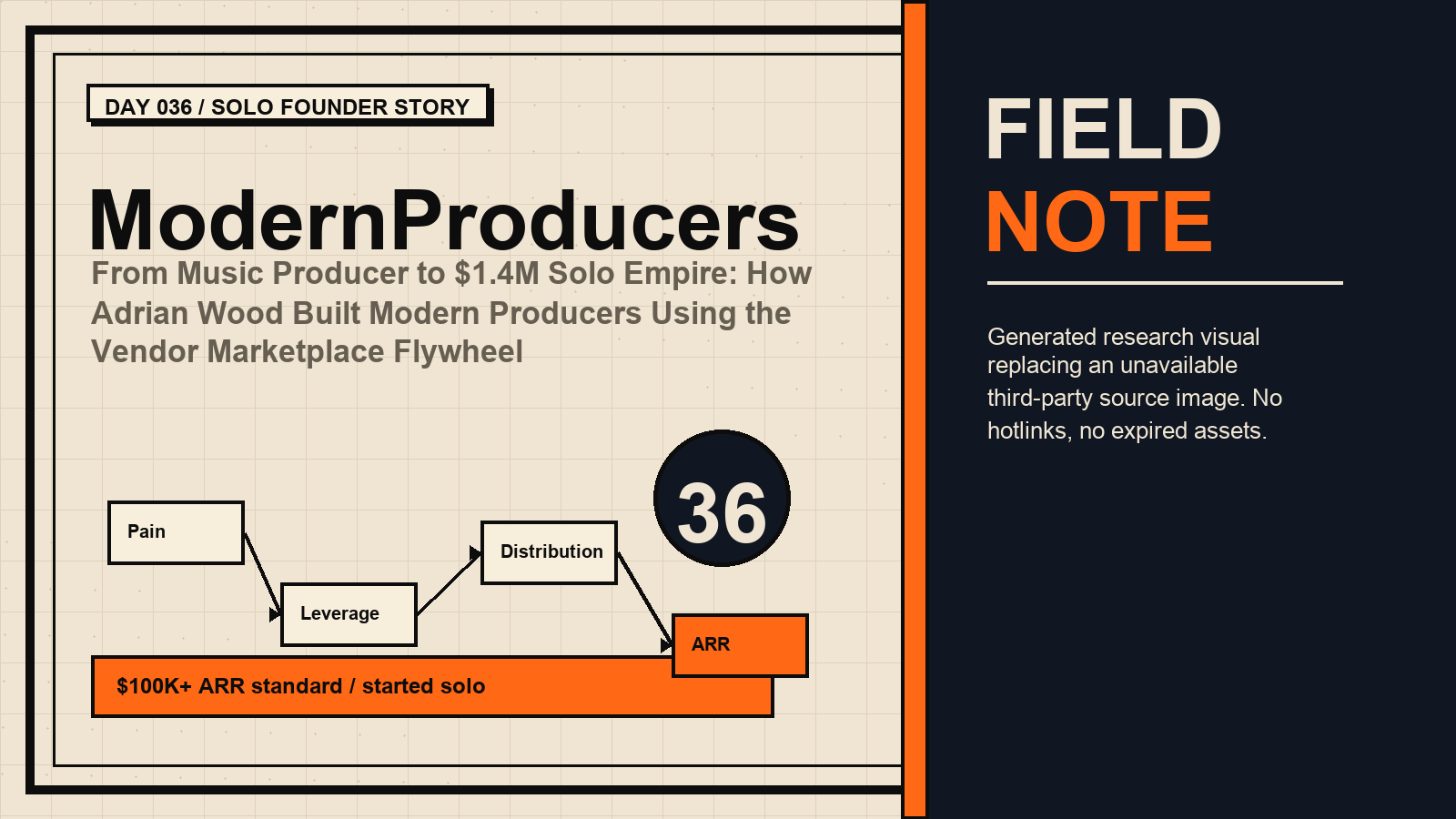 Visual representation of a modern music production marketplace platform
What the Founder Did Differently
Adrian Wood didn't start from zero—he leveraged his existing credibility as a music producer who had worked with 50 Cent, Snoop Dogg, and Wu-Tang Clan. But his real competitive advantage came from recognizing a fundamental constraint: one person cannot create enough high-quality content to satisfy a diverse market.
 Adrian Wood, CEO of modern producer, image source.

- Built a curated platform instead of a content factory - Rather than trying to produce everything himself, Wood invited established producers to sell through Modern Producers, dramatically expanding the catalog while maintaining quality standards
- Positioned himself as the curator, not the creator - Wood's role became selecting the best producers and maintaining brand standards, which required his expertise but not his time for every product
- Created win-win vendor relationships - Producers got access to Modern Producers' audience and marketing systems, while Wood got infinite content scaling without the production overhead
- Focused on systems over hustle - Wood won his first ClickFunnels 2 Comma Club award in 2018, proving he had built a million-dollar sales funnel that worked without constant manual intervention This approach solved a critical problem many solo founders face: the content creation bottleneck. While competitors were limited by their own production capacity, Wood's platform could add dozens of new products weekly through his vendor network.
The Growth Flywheel: Step-by-Step
Modern Producers' evolution from startup to $1.4M business followed a deliberate sequence where each stage created irreversible competitive advantages:
The critical insight in this flywheel is how Wood used other people's content creation as his primary scaling mechanism. By stage 3, the vendor marketplace became self-reinforcing: more vendors attracted more customers, which attracted more vendors, creating a network effect that competitors couldn't easily replicate.
Each stage also built specific leverage that compounded over time. The Shopify migration in stage 2 wasn't just about having a better website—it unlocked automated fulfillment, integrated payment processing, and third-party app connections that enabled everything that followed.
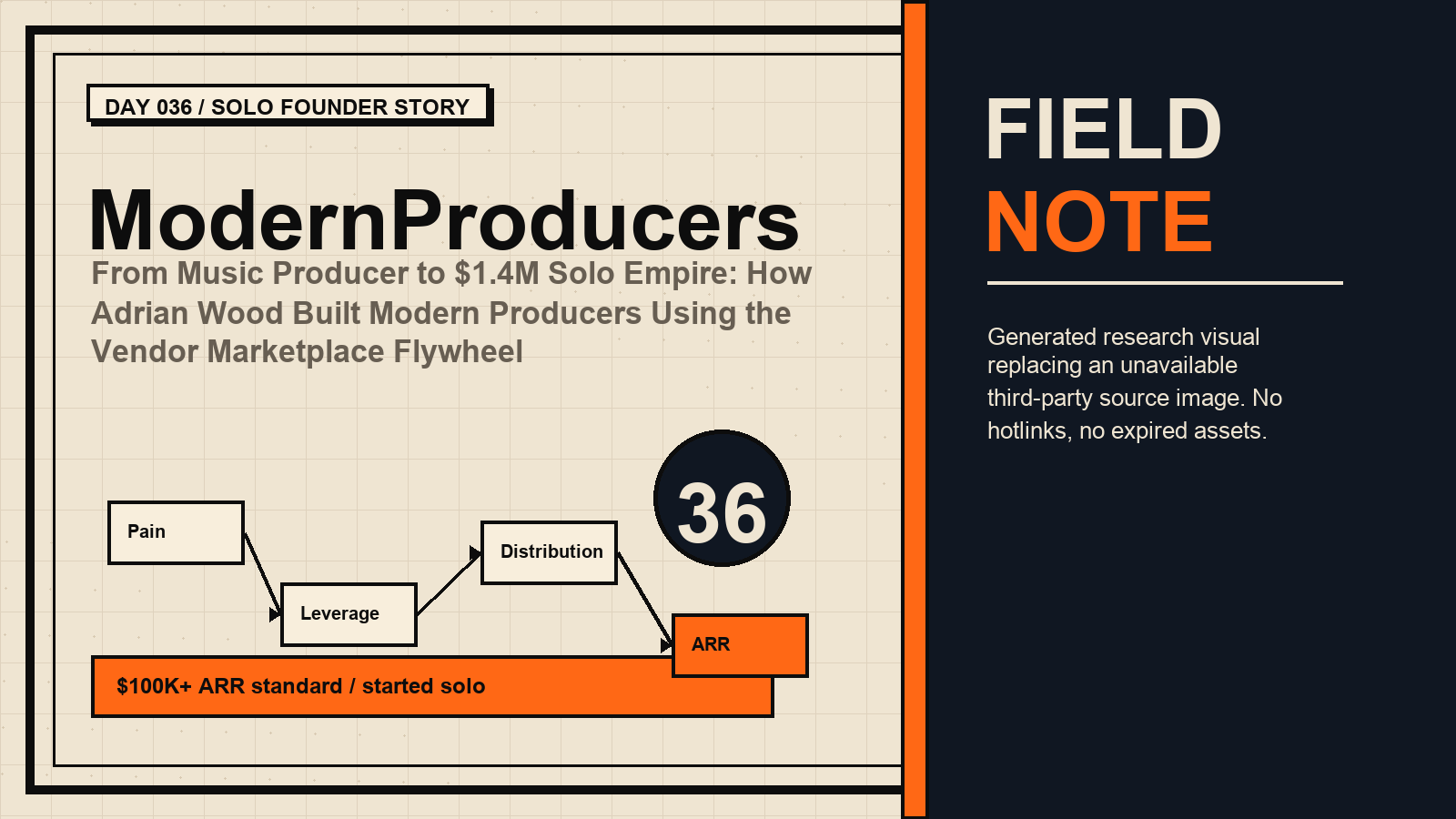 Modern Producers achieved steady growth from Adrian Wood's 2013 acquisition to $1.4M revenue by 2023, with key inflection points at the Shopify relaunch and ClickFunnels success.
Strategic Leverage & Business Model
Wood gained leverage through four key mechanisms that allowed massive output with minimal input: Vendor Network Leverage: By 2023, Modern Producers hosted content from hundreds of producers, creating a catalog no single creator could match. The platform took a percentage of each sale while vendors handled creation, essentially turning competitors into profit centers. Automation Stack: Wood's technical setup minimized manual work:
- ClickFunnels handled lead capture and sales conversion
- Facebook Messenger marketing achieved 80% open rates (vs. 15-20% with email)
- Shopify automated order fulfillment and digital delivery
- Subscription model created predictable recurring revenue Community Monetization: The Platinum Circle membership created multiple revenue streams—subscription fees, exclusive content access, and placement opportunities in commercial releases. This transformed one-time buyers into recurring revenue sources. Brand Authority: Wood's production credits with major artists provided instant credibility that competitors couldn't replicate. This authority allowed him to attract top-tier vendors and charge premium prices. The revenue model combined multiple streams: direct product sales, vendor marketplace commissions, subscription memberships, and custom services like beat tags and DJ drops. This diversification protected against any single revenue source declining.
Can You Replicate This Today?
A solo founder could absolutely rebuild Modern Producers faster and cheaper using 2024 technology: Marketplace Creation: No-code platforms like Bubble, Sharetribe, or even Shopify's advanced features can create sophisticated vendor marketplaces without custom development. What took Wood months of development could now be built in weeks. Content & Marketing:
- GPT-4 can generate product descriptions, marketing copy, and even music-related educational content at scale
- AI music tools can create sample content for demo purposes or to seed the platform initially
- Automated social media scheduling and content creation tools eliminate manual posting Vendor Onboarding:
- Zapier and similar automation tools can handle vendor applications, approval workflows, and payment setup automatically
- AI chatbots can answer common vendor questions and provide support
- Automated quality control systems can flag content that doesn't meet standards What's Easier Now vs. Still Hard: Easier: Building the platform (no-code tools), content creation (AI), customer service (chatbots), marketing automation (better tools), payment processing (simpler integrations) Still Hard: Building initial credibility and vendor relationships, maintaining quality standards, competing with established players like Splice and BeatStars, standing out in a crowded market The biggest change is that you no longer need Wood's music industry connections to succeed. AI can help create initial content to demonstrate platform quality, and data-driven marketing can build an audience without existing industry relationships.
Takeaways: How to Think Like This Founder
- Scale through other people's content creation - Don't try to produce everything yourself; build systems that let others create while you take a percentage of the value
- Automate the money-making processes first - Wood prioritized sales funnels and conversion automation over flashy features, ensuring every dollar spent on traffic generated maximum return
- Use subscription models to create predictable revenue - One-time sales are harder to scale than recurring revenue; build community and ongoing value delivery into your core model
- Leverage existing authority in adjacent markets - Wood's music production credentials translated directly to credibility in the music tools space; identify how your existing skills create marketplace advantages
- Build vendor relationships as competitive moats - Once you have the best suppliers in your marketplace, competitors can't easily replicate your catalog or quality standards
- Focus on systems that work while you sleep - Every aspect of Wood's business could run without his direct involvement, from content delivery to customer acquisition to vendor payments
Part of the 100 Days, 100 Solo Startups series.