
Field Note / day-20-baremetrics
From 7-Day Side Project to $1M ARR: How Baremetrics Won on Radical Transparency
In 2013, designer-developer Josh Pigford had one aching problem: PopSurvey—his SaaS at the time—couldn’t show him basic...
Answer Engine Brief
This case study is part of Jesse's 100-day founder marathon for Solo Unicorn Club: stories of solo or near-solo founders who reached meaningful revenue gravity and left reusable lessons about product, distribution, AI leverage, and one-person company design.

In 2013, designer-developer Josh Pigford had one aching problem: PopSurvey—his SaaS at the time—couldn’t show him basic subscription metrics like MRR, churn, or LTV. So he grabbed coffee, opened his text editor, and coded a solution in seven scattered evenings. Then he fired off a single tweet:
“Built a little dashboard for my Stripe data… anyone else need this?” That tweet birthed Baremetrics, the analytics platform that later surpassed $1 million in Annual Recurring Revenue (ARR) and became the poster child of radical transparency in tech.
Portrait of Josh Pigford, founder of Baremetrics, smiling confidently against a white brick wall background.
The Three Pillars Behind Baremetrics’ Breakout
1️⃣ Founder-Problem Fit: Pain First, Product Second
Before Baremetrics, Pigford had launched dozens of side projects—TrackThePack, Temper, PopSurvey, and more. Most were “vitamins” (nice-to-have tools). The difference this time? Baremetrics was a painkiller for his own mission-critical headache.
- Stripe-specific need: In 2013, Stripe had no native SaaS dashboard. Pigford’s MVP simply surfaced MRR, ARPU, churn, and LTV.
- Instant validation: Within weeks, the side project earned more than his existing products combined.
- Built-in audience: Every Stripe user felt the same pain, so word of mouth spread organically. Lesson: Solve a problem so personal you can’t sleep until it’s fixed; the market of peers will appear almost automatically.
2️⃣ Radical Transparency: Turning Honesty into a Marketing Engine
Pigford’s “lazy” decision to display Baremetrics’ real data instead of dummy screenshots unlocked a growth flywheel he never planned for:
- Open Demo: Anyone could explore live MRR, churn, and cash-flow graphs.
- “Open Startup” Blog: He shared monthly revenue bumps and embarrassing dips, making every post feel like reality TV for founders.
- Community Magnet: Transparency signaled competence and humility, drawing inbound links, press, and SEO juice. The result? Buffer, ConvertKit, and other well-known SaaS companies followed suit, embedding Baremetrics widgets on their own sites—free distribution Pigford couldn’t have paid for. Takeaway: When budgets are microscopic, trust is currency. Public metrics let prospects verify your claims instantly—no ad dollars required.
3️⃣ Value Alignment: Growing When Customers Grow
A stylish dashboard is nice; revenue-saving tools are loved. Baremetrics evolved in three waves:
| Wave | “Must-Have” Add-On | Outcome |
|---|---|---|
| v1 | Recover – retries failed payments automatically | Reduced delinquent churn for users, immediately paying for itself |
| v2 | Cancellation Insights – collects exit reasons & triggers win-back emails | Turned lost revenue into feedback loops |
| v3 | Forecast+ (via Flightpath acquisition) – scenario modeling | Helped founders plan hiring & runway |
Crucially, pricing scaled with a customer’s own MRR. Win-win math: if Recover saves a startup $5k, paying Baremetrics an extra $100 feels trivial. In 2022, after extensive A/B tests, prices increased 250%—a controversial move that worked because the platform’s ROI was indisputable.
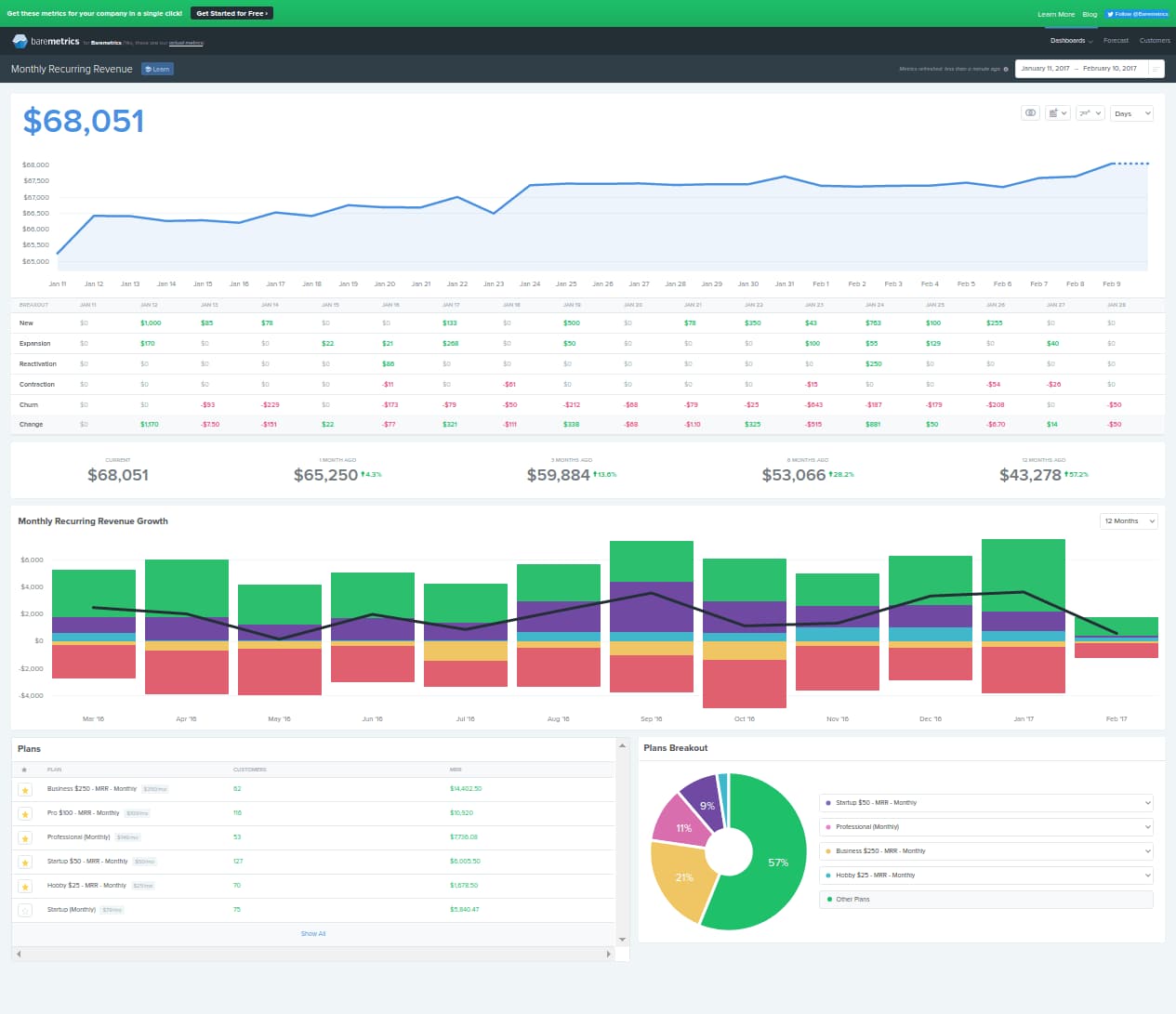 Baremetrics dashboard displaying Monthly Recurring Revenue trends, plan breakdowns, and growth metrics for a subscription business.
Lesson: Align your billing with customer success. When they earn more, they’re happy to pay you more.
Baremetrics dashboard displaying Monthly Recurring Revenue trends, plan breakdowns, and growth metrics for a subscription business.
Lesson: Align your billing with customer success. When they earn more, they’re happy to pay you more.
How to Replicate the Playbook in 2025
Step 1 — Build for Your Burn
Skip brainstorming “good ideas.” Instead, audit your day for repetitive pain. Whether it’s reconciling Stripe webhooks or wrangling Notion pages, that annoyance is a pre-qualified market gap. Your founding story will market itself.
Step 2 — Market by Default
No growth budget? Perfect. Make your work impossible to ignore:
- Publish your roadmap in public; ship changelogs on social.
- Open-source ancillary tools or documentation—developers love peeking under the hood.
- Share misses as openly as wins; vulnerability breeds loyalty.
Step 3 — Bake Alignment into Pricing
Bill on value metrics (MRR, active seats, API calls) rather than vanity metrics (storage, custom domains). That creates subconscious partnership—customers cheer when you charge them more because it means they’re scaling.
AI: The Transparency Multiplier
Baremetrics’ early edge was founder phone calls and raw candor. In 2025, AI gifts solo founders the ability to keep that intimacy at scale.
| Need | 2013 Solution | 2025 AI Upgrade |
|---|---|---|
| Customer feedback | Manual Zoom chats | NLP sentiment analysis classifying 1,000 tickets overnight |
| Marketing copy | Founder blog posts | LLM-drafted threads edited for personal voice |
| Price testing | Gut feeling | Reinforcement-learning agents optimizing tiers vs. churn cohort data |
| Support | Founder inbox | AI chat widgets triaging 24/7 while surfacing edge cases for human touch |
But beware: Transparency now extends to sharing your AI prompts, datasets, and model glitches. Audiences crave authenticity in the age of synthetic content.
Quick-Hit Takeaways for Aspiring Solo Founders
- Painkiller beats vitamin. Scratch your own itch so intensely that shipping feels like relief, not effort.
- Transparency is viral. Public dashboards beat polished landing pages every time.
- Tools → Workflows → Ecosystem. Start narrow, then move “up the Stack” to adjacent jobs customers already do.
- Price on outcomes. If you save clients $10k, charging $299/month is philanthropy, not greed.
- Leverage AI, but stay human. Automate insight gathering; keep decision-making personal.
Final Thoughts: Radical Transparency 2.0
The glass-box ethos Pigford championed isn’t a gimmick—it’s a moat. Data that used to hide behind NDAs is now a public trust signal. As AI floods feeds with polished prose, the scrappy screenshot of an actual Stripe payout has never looked more credible.
We’re entering a decade where founders who “build in public” will outpace those who “stealth until perfect.” Baremetrics’ journey—from a 7-day hack to a $1 M ARR cornerstone—proves it.
Ready to test your own painkiller idea? Tweet your first screenshot today, tag me, and let’s cheer on the next radically transparent success story.
 A modern building with a transparent glass facade symbolizing openness and radical transparency in business.
Comment below: What’s one metric you’d dare to publish publicly?
DM me if you’re turning that transparency into a product—I’d love to feature your build in the next breakdown.
#SoloFounder #Baremetrics #BuildInPublic #SaaS #Transparency #AI #Startups
A modern building with a transparent glass facade symbolizing openness and radical transparency in business.
Comment below: What’s one metric you’d dare to publish publicly?
DM me if you’re turning that transparency into a product—I’d love to feature your build in the next breakdown.
#SoloFounder #Baremetrics #BuildInPublic #SaaS #Transparency #AI #Startups