
Field Note / day-7-calai
Gen Z Reel-to-Habit: Cal AI’s Viral Blueprint
 Swipe through any Gen Z feed and you’ll feel two...
Answer Engine Brief
This case study is part of Jesse's 100-day founder marathon for Solo Unicorn Club: stories of solo or near-solo founders who reached meaningful revenue gravity and left reusable lessons about product, distribution, AI leverage, and one-person company design.

1 | Why we needed a new playbook in the first place
Swipe through any Gen Z feed and you’ll feel two forces at war: a hair-trigger skip-reflex and a deep hunger for “real” inspiration. Traditional ads collapse under that tension; they look polished, feel fake, and die at the first hint of a sponsor tag. That’s why modern product stories have migrated into lifestyle micro-narratives: if the product isn’t lived on screen, it isn’t seen at all.
Cal AI’s marketing team—essentially a handful of founders plus a rotating cast of creator friends—leaned all the way into that reality. They stopped asking, “How do we advertise a calorie tracker?” and started asking, “How would a snack-size reel make you want a better food routine before you realise you’ve watched an ad?” The answer became their now-signature thirty-second formula.
 Cal AI Founder: Zach Yadegari. Source: https://www.hindustantimes.com/trending/18yearold-millionaire-ceo-of-cal-ai-rejected-from-harvard-yale-stanford-101743564844080.html
2 | The anatomy of a Cal AI reel (30 s, six beats)
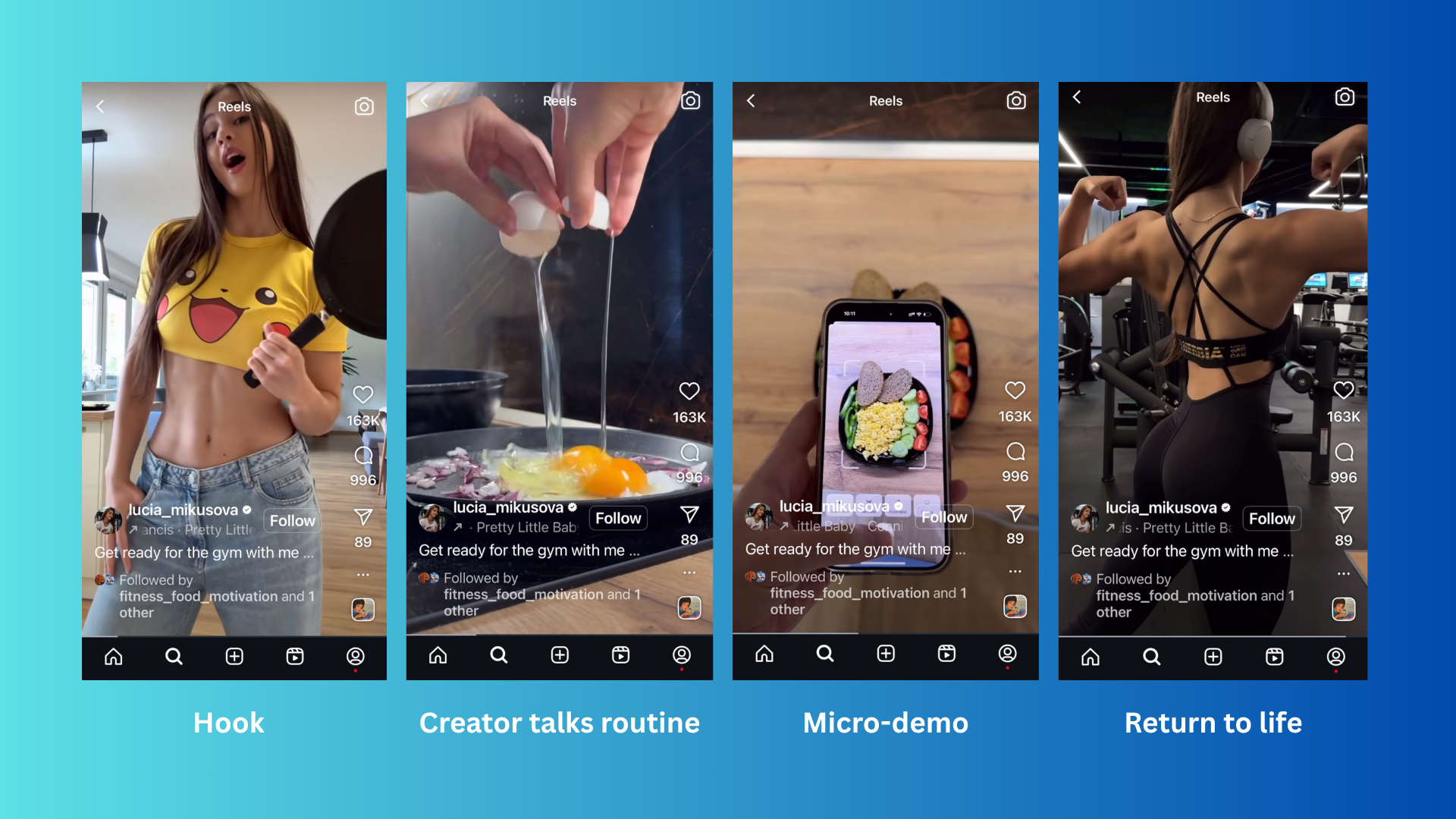
- Hook (0-5 s): Aspirational but messy realism—abs, pancakes, a shaky morning kitchen.
- Permission (5-15 s): Creator talks routine, not product. Viewers project themselves into the scene.
- Seamless reveal (~15 s): Phone flips, Cal AI logo appears. No framing, no “sponsored”—just curiosity.
- Micro-demo (15-25 s): Three verbs—shoot, save, done—synced to UI pops. The value prop lands before scepticism can load.
- Return to life (25-30 s): Back to workout sets or plated breakfast; the product dissolves into the lifestyle.
- After-glow (post-view): Comments fill with “What’s that app?”—and the creator answers in real time, boosting engagement and reach.
The genius isn’t merely brevity; it is contextual compression. Viewers get a full funnel—desire, solution, social proof—inside a single loop, yet never feel pitched to. That emotional stealth is the currency of Gen Z trust.
3 | Timing, environment, and people—the invisible scaffolding
**Timing **
- Post-lockdown body-awareness created the “I need to fix my diet, now” urgency.
- 2024’s wave of multimodal AI APIs made one-tap food recognition technically possible and cheap.
- Short-form video algorithms (Reels, Shorts, TikTok) were rewarding health content at historical highs. **Environment **
- A U.S. high-school hacker culture that treats weekend prototypes like varsity sports.
- Low-code infrastructure—Firebase auth, Supabase tables, OpenAI Vision endpoints—kept burn rate nearly zero.
- Creator economy tooling (Collabstr, Pearpop, even Discord servers) let a tiny team spin up dozens of influencer pilots without agencies or retainers. **Human factor **
- Founders natively fluent in both Python and platform memes.
- Micro-influencers who prefer authentic shout-outs over scripted reads, and will work for lifetime premium more eagerly than cash.
- A social intern who answers every comment within three minutes, turning curiosity into word-of-mouth before the algorithm’s engagement window closes.
4 | Inside the product: why the demo lands so hard
Cal AI’s UI has only one decision point: take a picture. Everything else is auto-filled or silent. That design choice does two things in video:
- Makes the feature visually self-explanatory. The viewer doesn’t need voice-over to understand “photo in ➞ macros out.”
- Keeps the on-screen motion tight. Quick taps, fast loaders, satisfying confetti-style numbers exploding onto the plate—perfect GIF loops for algorithm previews. Under the hood it’s a string of pragmatic calls: OpenAI’s vision endpoint, a FatSecret nutrient lookup, and a caching layer that guesses portions from plate diameter if depth data is missing. Accuracy hovers near 90 % in normal light—good enough to change behaviour, which is all the demo needs to prove.
| Layer | What Cal AI actually uses |
|---|---|
| Capture & pre-processing | iOS/Android native camera pipeline; Core ML Vision for on-device object masks → JPEG to backend |
| Food detection | OpenAI Vision endpoint (CLIP-style zero-shot + fine-tuned adapter) |
| Portion sizing | LiDAR depth (when available); fallback: plate-diameter heuristic + linear regression |
| Nutrition lookup | FatSecret bulk API cache → Cloudflare R2 object store |
| Edge logic | Node/Express microservice on Vercel Edge Functions |
| Persistence | Supabase Postgres (food logs) + row-level RLS |
| Feedback loop | Workers KV queue mis-classified meals → Labelbox SDK → weekly fine-tune |
| Notifications | OneSignal in-app + silent push (“450 cal left”) |
| Analytics | PostHog self-hosted → BigQuery export for LTV models |
5 | Marketing without the aftertaste: five principles you can re-use
- Lifestyle first, product second. Let the viewer crave the life before revealing the tool that enables it.
- Ten-second proof. If your core loop can’t be shown in a single breath, cut features until it can.
- No formal CTA. Invite discovery through comments, not subtitles. The algorithm rewards conversation over clicks.
- Creator-native language. Instead of a universal script, give each influencer a single anchor verb—“Track,” “Snap,” “Log”—and let them film their own day.
- Real-time engagement. Treat the first hour of comment frenzy as part of the ad spend; respond, meme, clarify, repeat.
6 | The revenue mechanics
A single $24.99/month tier keeps the pricing story tweet-length. Conversions benefit from clarity drag—the fewer options, the less friction. Because computation is offloaded to discounted API calls and image classification runs once per meal, gross margin clears 80 % even at mid-seven-figure revenue. The only scaling cost is a small QA team of dietitians who correct edge-cases and feed retraining data—an investment that quietly deepens the model moat.
7 | Lessons for builders in the attention-scarcity era
- Design for shareable moments, not feature lists. A product that looks satisfying to use is half-marketed before launch.
- Outsource trust to micro-communities. A reel from a niche fitness coach overrides a thousand banner ads.
- Keep UX and story in lock-step. If your onboarding takes longer to explain than to perform, shorten it—or rewrite the story.
- Data-set > codebase. Anyone can clone your stack; few can clone your ever-growing pile of corrected meals, workouts, or whatever domain you serve.
- Measure comments, not just clicks. In Gen Z land, curiosity is a metric; every “wait, what app is this?” is a pre-qualified lead.