
Field Note / a-50
The Complete 2026 AI Agent Tech Stack — A Full-Stack Guide from Model to Deployment
Over the past year, I've built quite a few Agent systems — content production pipelines, customer support bots, code...
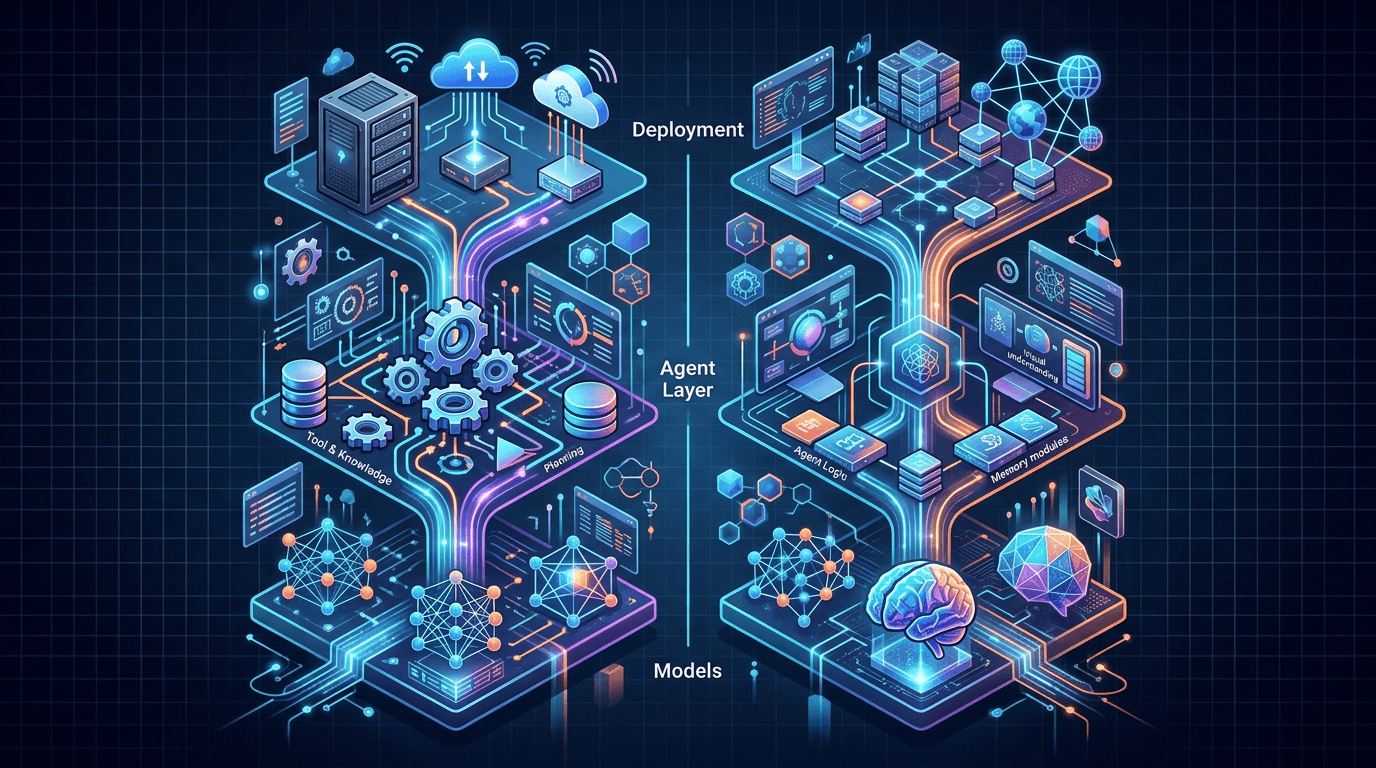
The Complete 2026 AI Agent Tech Stack — A Full-Stack Guide from Model to Deployment
Over the past year, I've built quite a few Agent systems — content production pipelines, customer support bots, code review Agents, multi-step data extraction pipelines. Every time I started from scratch, I found myself making the same decisions all over again in the same pool of tools: which framework? which vector database? which monitoring solution?
This article captures the selection logic I've refined through real-world experience. It's not a feature list — it's meant to help you make a decision at every layer.
Layer 1: Models
The model is the core variable in the entire stack. By 2026, the top three providers have carved out clearly distinct positions.
Claude (Anthropic)
My go-to for tasks requiring long-context reasoning and accurate tool calling. Claude Opus 4.5 currently ranks first on SWE-bench coding benchmarks at 74.4%, and what that number means in practice is this: for complex task decomposition, multi-step reasoning, and code generation, Claude delivers the most consistent reliability.
The most tangible takeaway from real-world usage: Claude is exceptionally reliable at following system prompts. Give it a detailed Agent role definition, and it executes strictly according to spec with very little role drift. For long-running automation pipelines, this consistency matters far more than one-off "cleverness."
→ Best for: Code Agents, long document processing, workflows requiring strict instruction adherence → Pricing reference: Claude Sonnet 4.5 at approximately $3/$15 (input/output, per million tokens)
GPT-4o / GPT-5 (OpenAI)
GPT-4o has clear advantages in multimodal capabilities and tool ecosystem breadth. OpenAI's Function Calling spec has effectively become an industry standard — most frameworks prioritize OpenAI format compatibility for tool calling, which means you'll encounter the fewest integration headaches when using GPT models.
After GPT-5's release, instruction following and tool-use accuracy improved significantly. For the Agent orchestration layer (having one model dispatch multiple other Agents), GPT-4o's low latency makes it a common choice as the orchestration core.
→ Best for: Multimodal tasks, scenarios requiring the broadest tool integration, orchestration layer → Ecosystem advantage: Highest integration maturity with LangChain, CrewAI, and other frameworks
Gemini 3 Pro (Google)
Gemini 3 Pro differentiates on two fronts: a 1-million-token context window and full video processing capabilities. The former makes it irreplaceable for scenarios requiring single-pass processing of massive document sets; the latter is currently unique among top-tier models.
With an SWE-bench score of 74.2%, it's neck-and-neck with Claude. If your infrastructure runs on Google Cloud, or your workflows involve extensive Google Workspace data, Gemini's ecosystem integration advantage becomes significant.
→ Best for: Ultra-long document analysis, video understanding tasks, Google Cloud-native scenarios → Pricing: $2–4/$12–18 (input/output, per million tokens), free tier available
Model Layer Selection Matrix
| Scenario | Recommended Model | Reason |
|---|---|---|
| Code generation/review | Claude Opus 4.5 | #1 on SWE-bench, most stable instruction following |
| Multi-tool orchestration Agent | GPT-4o | Most mature Function Calling ecosystem |
| Ultra-long document processing | Gemini 3 Pro | 1M token context window |
| Cost-sensitive high-volume requests | Gemini 3 Pro | Lowest pricing, free tier available |
| General multi-step reasoning | Claude Sonnet 4.5 | Best price-performance reasoning model |
Layer 2: Frameworks
The framework layer determines how much "freedom" your Agent has and how complex a "topology" it can support.
LangChain / LangGraph
LangChain is the infrastructure of this space. 126,000 GitHub stars isn't just a popularity metric — it means virtually every tool, database, and model already has a ready-made LangChain integration. Whatever you want to use, there's a good chance someone has already built the connector.
That said, LangChain's own abstraction layers run deep, making code verbose. Since 2024, the team has clearly shifted focus to LangGraph (24,000 stars). LangGraph uses directed graphs to describe Agent state transitions, which is a better fit than linear chains for handling conditional branching, loops, and parallel nodes — the stuff real-world scenarios actually demand.
My take: Use LangChain for quick prototypes and single-Agent tasks. Reach for LangGraph when you need state management in multi-Agent systems.
→ Best for: Scenarios requiring the broadest tool integration, teams with LangChain experience → GitHub Stars: LangChain 126k, LangGraph 24k
CrewAI
CrewAI's core philosophy is "role-play-based multi-Agent collaboration": you define a group of Agents with different roles (Research Agent, Writer Agent, QA Agent), assign them tasks, and they negotiate to completion.
Released in early 2024, it has already reached 44,300 GitHub stars and 5.2 million monthly downloads — the fastest growth among new frameworks. CrewAI's biggest advantage is speed to first result: compared to LangGraph's graph definitions, CrewAI's Agent declarations are highly intuitive, and 10 lines of code can run a meaningful multi-Agent task.
The weakness is control precision for complex workflows. If your Agent requires very precise state management or sophisticated error recovery logic, CrewAI's abstraction layer can sometimes make debugging difficult.
→ Best for: Rapid multi-Agent prototyping, scenarios centered on role-based collaboration → GitHub Stars: 44,300; Monthly downloads: 5.2M
Framework Layer Selection Logic
Independent developer, first Agent project → CrewAI. Fast results, gentle learning curve.
Team, needs fine-grained control → LangGraph. Graph structures make complex workflows maintainable.
Existing large LangChain codebase → Don't migrate. LangGraph is backward-compatible.
Layer 3: Visual Orchestration
Not everyone wants to write code. Visual orchestration tools let people without engineering backgrounds build Agent workflows.
n8n
n8n's positioning in the AI Agent orchestration space is crystal clear: self-hosting friendly, workflow automation, native LangChain integration. At its core, it's a business process automation tool, but after integrating LangChain, it became a complete platform for building production-grade AI workflows.
n8n supports horizontal scaling (queue-based architecture), and for scenarios requiring concurrent processing of large task volumes, its production-readiness exceeds most competitors. The self-hosted version is completely free; the Cloud version charges by execution count.
→ Best for: Teams with technical backgrounds who don't want to write framework code, workflows that need integration with existing SaaS tools
Dify
Dify currently has 130,000 GitHub stars and raised $20 million in Series A funding in late 2025. It brings the entire Agent development lifecycle into a single interface: visual workflow editor, built-in RAG pipeline, usage monitoring, multi-tenant permission management, and the ability to publish applications as standalone URLs.
Compared to n8n, Dify leans more toward being an AI application platform rather than a workflow automation tool. If your goal is to package an Agent as a product for end users, Dify offers more complete end-to-end support.
→ Best for: Packaging Agents as products for end users, scenarios where non-technical team members participate
Orchestration Layer Comparison
| Dimension | n8n | Dify |
|---|---|---|
| GitHub Stars | Not disclosed (proprietary data) | 130,000+ |
| Positioning | Workflow automation + AI | AI application platform |
| Technical Barrier | Low (visual + light JS) | Low (purely visual) |
| Production Operations | Strong (queues, horizontal scaling) | Moderate (Docker, complex config) |
| Built-in RAG | Requires external integration | Built-in, out of the box |
| Pricing | Self-hosted free, Cloud billed per execution | Cloud from $59/mo, Community Edition free |
Layer 4: Vector Databases
The Agent's memory system. Choose wrong, and migration costs down the road are steep.
Pinecone
The most reliable managed option. Core strengths are low latency and high throughput — maintaining stable query performance even at billion-vector scale. No infrastructure to manage; billed by index and query volume.
If your team has limited engineering resources and doesn't want to spend time on vector database operations, Pinecone is the least hassle. The downside is pricing that increases significantly at large scale.
→ Best for: Quick production launches, teams with limited engineering capacity
Qdrant
Built in Rust, known for performance and precise metadata filtering. When your retrieval needs combine "vector similarity + complex conditional filtering" (e.g., find similar documents, but only within a specific user ID and time range), Qdrant's filtering capabilities are more flexible and efficient than most competitors.
Supports self-hosting, making it a strong competitor to Pinecone in high-throughput self-hosted scenarios.
→ Best for: Scenarios requiring complex metadata filtering, cost-sensitive high-throughput self-hosted setups
Weaviate
Knowledge graph capabilities are Weaviate's differentiator. If your Agent needs to understand structural relationships between data (not just similarity), Weaviate's GraphQL interface and hybrid search (vector + keyword) can handle more complex retrieval logic.
→ Best for: Hybrid search needs, data with complex relational structures
Chroma
The best choice for development and prototyping. Python-native, one-line pip install, 5 minutes to a running local RAG. The classic community migration path is: prototype with Chroma, migrate to Pinecone or Qdrant before going to production.
→ Best for: Local development, rapid prototyping — not recommended for direct production use
Vector Database Selection Matrix
| Scenario | Recommendation |
|---|---|
| Rapid prototyping / local development | Chroma |
| Production managed, no ops overhead | Pinecone |
| Production self-hosted, complex filtering needed | Qdrant |
| Knowledge graph + hybrid search required | Weaviate |
Layer 5: Deployment
How you deploy your Agent system determines its scalability and maintenance burden.
Containerization is the standard answer. Regardless of framework, the mainstream production path is packaging in Docker containers and deploying via Kubernetes or cloud-native services (AWS ECS, GCP Cloud Run, Azure Container Apps).
A few practical deployment considerations worth noting:
→ Stateless design: The Agent itself holds no state; all state goes into external databases (Redis for short-term caching, PostgreSQL for persistence). This eliminates state synchronization issues when scaling horizontally.
→ Queue decoupling: Agent tasks are processed asynchronously through message queues (Redis Queue, RabbitMQ, AWS SQS), preventing long-running Agent requests from blocking API responses. n8n's queue mode is a standard implementation of this pattern.
→ Timeout and retry strategies: LLM call latency is unpredictable. You must configure reasonable timeouts at the framework level (recommended 30–120 seconds) with exponential backoff retry. Without this, production environments will experience frequent cascading failures.
Layer 6: Monitoring and Observability
Agent systems are notoriously hard to debug because their behavior is non-deterministic. A single "failure" might originate from model output, tool calls, or data retrieval — any layer. Without good monitoring, you're essentially guessing.
LangSmith
Built by the LangChain team, with near-zero-configuration integration for LangChain/LangGraph. Its core capability is trace tracking: every Agent run, every node's inputs and outputs, duration, model used, and token consumption — all visually displayed.
In real-world testing, LangSmith's performance overhead is negligible (<1%), which is an important metric for production environments. It supports any LLM framework, not just LangChain.
→ Best for: LangChain ecosystem users, teams needing detailed traces
Langfuse
An open-source, self-hostable observability platform. It has the best debugging UX in its category: trace visualization, session management, prompt version control, and cost attribution — all out of the box, with SDK integration typically taking just a few hours.
For teams that don't want to upload all runtime data to a third-party platform (data compliance requirements), Langfuse's self-hosting option is a key advantage.
→ Best for: Teams requiring self-hosting, high cost transparency demands
Arize Phoenix
Arize's strength lies in model-level metric monitoring — with a traditional ML Ops pedigree, backed by infrastructure that has processed over 1 trillion inferences. Phoenix is the open-source version; AX is the enterprise edition.
For teams that need to monitor both traditional ML models and LLM Agents simultaneously, Arize provides a unified monitoring plane. However, if you're exclusively building LLM Agents, Phoenix's multi-step trace analysis isn't as detailed as LangSmith's.
→ Best for: Enterprise teams managing both ML models and LLM Agents
My Recommended Configurations
Different scales and objectives call for different reasonable choices:
Independent developer, first Agent product → Model: Claude Sonnet 4.5 (best reasoning-to-price ratio) → Framework: CrewAI (fastest to results) → Vector DB: Chroma for local development, Pinecone for production → Orchestration: Dify (if a non-technical co-founder needs to participate) → Monitoring: Langfuse (open source, self-hosted, free to start)
Small technical team (3–10 people), with backend engineers → Model: Claude Opus 4.5 (primary) + GPT-4o (orchestration/multimodal) → Framework: LangGraph (state management capability required) → Vector DB: Qdrant self-hosted (cost control + complex filtering needs) → Orchestration: n8n (integration with existing business systems) → Monitoring: LangSmith (frictionless integration with LangGraph)
Enterprise team, with compliance and security requirements → Model: Private deployment or compliant API solutions (Azure OpenAI / Amazon Bedrock) → Framework: LangGraph + enterprise toolchain → Vector DB: Weaviate self-hosted (knowledge graph needs + data sovereignty) → Monitoring: Langfuse self-hosted or Arize AX
Full-Stack Overview
| Layer | Tool | Starting Price | Recommended Scenario |
|---|---|---|---|
| Model | Claude Opus 4.5 | ~$15/M output tokens | Code, reasoning, long documents |
| Model | GPT-4o | Usage-based | Multi-tool orchestration, multimodal |
| Model | Gemini 3 Pro | $2/M input tokens | Ultra-long context, Google ecosystem |
| Framework | LangChain/LangGraph | Open source, free | Fine-grained state control |
| Framework | CrewAI | Open source, free | Rapid multi-Agent prototyping |
| Orchestration | n8n | Self-hosted free | Workflow automation |
| Orchestration | Dify | Community Edition free | AI application platform |
| Vector DB | Pinecone | Usage-based | Managed, fast to production |
| Vector DB | Qdrant | Open source, free | Self-hosted, high-performance filtering |
| Vector DB | Chroma | Open source, free | Local development prototyping |
| Monitoring | LangSmith | Free tier available | LangChain ecosystem |
| Monitoring | Langfuse | Open source, self-hosted | Privacy-sensitive scenarios |
Conclusion
There's no silver bullet for the 2026 AI Agent tech stack. Every layer has two to three genuinely viable options, and the differences come down to your team size, technical background, data compliance requirements, and whether you prioritize speed-to-results or long-term maintainability.
One piece of advice: In an era where every layer has open-source, self-hostable options, start by validating your core logic with open-source tools, then consider paid managed services later. This sequence saves you a great deal of time and money that would otherwise go to premature optimization.
What tech stack are you currently using to build Agents? Which layer has given you the most trouble?