
Field Note / e-31
The One-Person Company OS
In 2024, I thought the future of a one-person company was a better tool stack. By 2026, I think that framing is too...
The One-Person Company OS
In 2024, I thought the future of a one-person company was a better tool stack.
By 2026, I think that framing is too small. Tools are raw material. The real advantage is an operating system.
Not an app. Not a dashboard. Not another productivity template.
I mean an actual company operating system: a way to decide what work exists, which AI agent should handle it, what context it receives, what it is allowed to touch, how the output gets reviewed, and what gets turned into a repeatable process.
This matters because "solo founder with AI tools" is quickly becoming the default. The harder question is: can one person design a company that AI agents can actually operate?
That is the difference between a busy solopreneur and a solo unicorn.
Why This Became Urgent in 2026
The public signals are not subtle.
OpenAI describes Codex as a command center for delegating software work to multiple agents. Anthropic's Economic Index shows that AI is already deeply concentrated in computer, math, writing, and analysis tasks. Stanford's 2026 AI Index shows that AI agents are improving fast on real-world computer tasks, but still fail often enough that human review remains critical. McKinsey's State of AI research keeps pointing to the same pattern: the companies getting value from AI are not just buying tools. They are redesigning workflows.
That is exactly the lesson for a one-person company.
If you only buy tools, you get more tabs.
If you redesign the workflow, you get leverage.
The best solo AI founders I know are not asking, "Which AI app should I subscribe to?" They are asking:
- What work can be expressed as a repeatable task?
- What context does the agent need to do it correctly?
- What should the agent never be allowed to do?
- What does a good output look like?
- What do I review before the work becomes real?
That is the architecture of a one-person company OS.
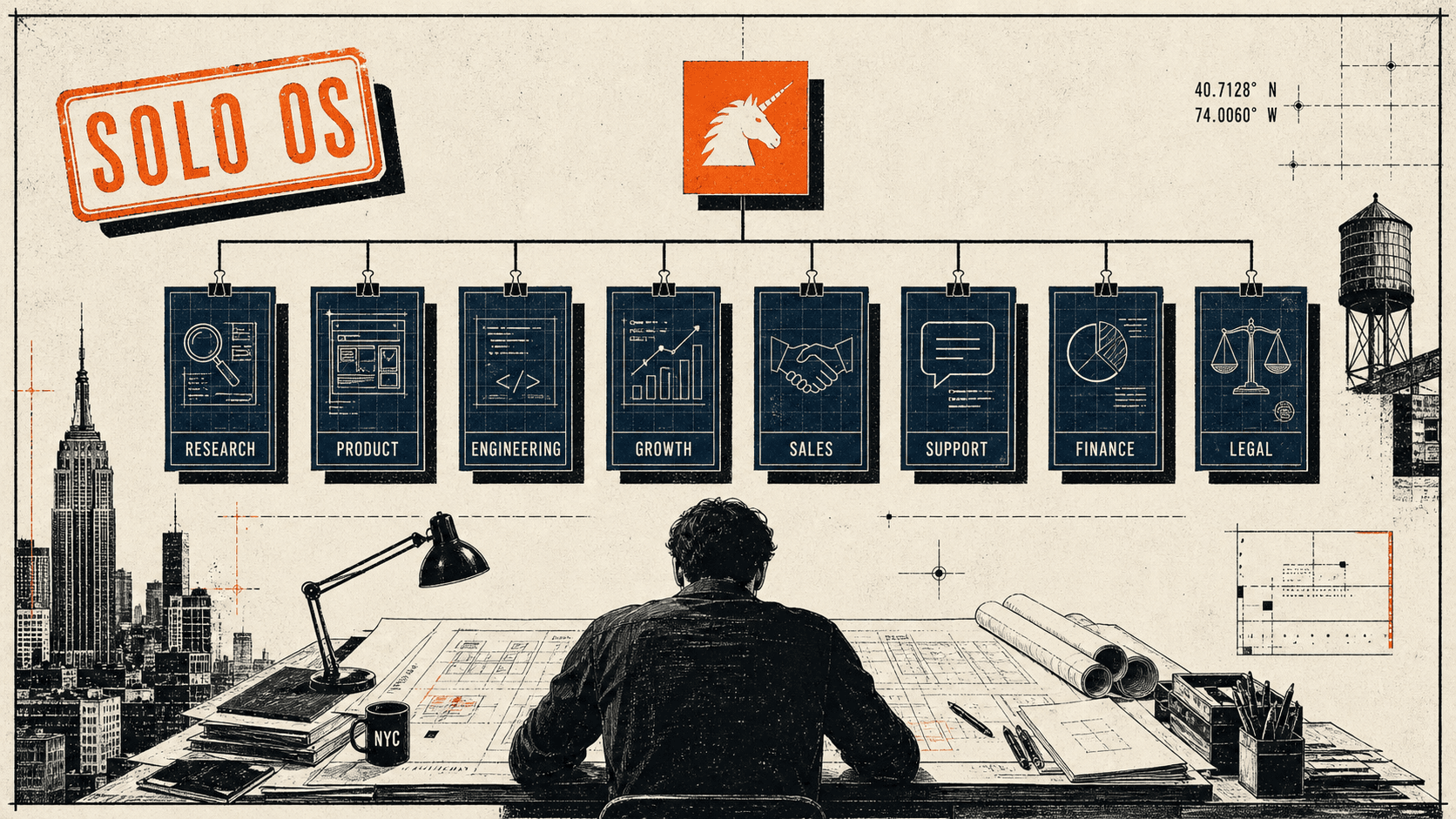
The Org Chart of a Solo AI Company
Here is the simplest version of the system I recommend.
You are not replacing yourself with AI. You are splitting the company into roles.
1. Research Agent
Job: monitor markets, competitors, customer language, funding announcements, tool releases, and industry shifts.
Inputs:
- RSS feeds
- Perplexity or search results
- customer calls
- Reddit and community discussions
- competitor pages
Outputs:
- weekly opportunity memo
- source list
- "what changed this week" summary
- article and product ideas
Human review: verify sources, reject weak signals, decide what matters.
2. Product Agent
Job: turn customer pain into feature proposals.
Inputs:
- support tickets
- user interviews
- analytics
- competitor feature changes
- internal product notes
Outputs:
- feature brief
- prioritization table
- edge cases
- acceptance criteria
Human review: decide roadmap priority.
3. Engineering Agent
Job: write, test, refactor, and document code.
Inputs:
- repo context
- task brief
- acceptance criteria
- design constraints
Outputs:
- pull request
- test plan
- risk notes
- deployment checklist
Human review: read the diff, run tests, check security and business logic.
4. Growth Agent
Job: turn product and founder insight into content, outreach, SEO pages, and community posts.
Inputs:
- article briefs
- keyword clusters
- event notes
- founder voice examples
- customer proof
Outputs:
- blog drafts
- LinkedIn posts
- newsletter versions
- SEO/GEO briefs
- landing page copy
Human review: sharpen the opinion, remove generic AI phrasing, protect the brand voice.
5. Sales Agent
Job: research accounts, draft outreach, prepare call briefs, and follow up.
Inputs:
- target account list
- ICP definition
- website research
- prior conversations
- offer details
Outputs:
- personalized outreach
- account briefing
- objection handling notes
- follow-up email
Human review: approve anything that reaches a real customer.
6. Customer Success Agent
Job: answer common questions, summarize issues, detect unhappy customers, and turn support conversations into product intelligence.
Inputs:
- help docs
- product changelog
- support inbox
- customer usage data
Outputs:
- suggested replies
- escalation flags
- FAQ updates
- churn risk memo
Human review: handle emotional, legal, financial, and high-value customer moments.
7. Finance Agent
Job: track subscriptions, invoices, cash flow, tax prep materials, and unit economics.
Inputs:
- Stripe exports
- bank transactions
- SaaS bills
- accounting categories
- sales pipeline
Outputs:
- weekly cash note
- expense audit
- renewal reminders
- tax prep folder
Human review: approve payments, filings, and any final financial decision.
8. Legal and Risk Agent
Job: read contracts, flag unusual clauses, monitor privacy obligations, and create risk summaries.
Inputs:
- contracts
- terms of service
- privacy policies
- vendor agreements
- customer commitments
Outputs:
- risk summary
- negotiation points
- unusual clause list
- legal question list for a human lawyer
Human review: never outsource final legal judgment to AI.
The Three Rules That Make This Work
Rule 1: Agents Need Job Descriptions
Most people give AI tasks. Operators give AI roles.
"Write a blog post" is weak.
"You are the Growth Agent for Solo Unicorn Club. Your job is to turn founder operating lessons into SEO and GEO optimized articles for solo AI founders, especially builders in New York and Chinese-speaking AI communities. Use a direct, specific, non-corporate tone. Never use generic AI phrases. Every draft must include a clear framework, a checklist, and search-friendly questions." That is much better.
The agent needs to know what kind of company it works for.
Rule 2: Agents Need Permission Boundaries
A one-person company can move fast because there are fewer meetings. That speed becomes dangerous if your agents can touch everything.
My default rule:
- read access before write access
- draft before send
- suggest before execute
- summarize before decide
- no money movement without human approval
- no customer-facing message without review until the workflow has proven itself
The goal is not to make AI passive. The goal is to create a path from low-risk autonomy to higher-trust autonomy.
Rule 3: Agents Need Review Loops
If an AI agent produces work and nobody reviews it, that is not automation. That is hidden risk.
For each agent, define the review artifact:
- Research Agent: source list and uncertainty level
- Product Agent: acceptance criteria and trade-offs
- Engineering Agent: diff and test results
- Growth Agent: outline and final draft
- Sales Agent: account research and final email
- Customer Success Agent: escalation note
- Finance Agent: cash summary
- Legal Agent: risk memo
If the artifact is good, the founder can review fast. If the artifact is vague, the agent is not operational yet.
Why New York Solo AI Founders Have an Advantage
Solo Unicorn Club is based in New York for a reason.
New York is not just a tech market. It is a density market: finance, luxury, media, healthcare, legal, real estate, education, fashion, and global immigrant networks all collide in the same city.
That matters for a one-person AI company because the best opportunities are not generic "AI apps." They are workflow gaps inside real industries.
A solo AI founder in New York can spend Monday talking to a jewelry operator, Tuesday with a fintech founder, Wednesday with a media buyer, Thursday with a legal ops person, and Friday at an AI meetup. That is a better idea engine than sitting alone comparing model benchmarks.
Your one-person company OS should be built around that proximity.
Use the city as the research layer. Use AI agents as the execution layer. Use your judgment as the control layer.
The One-Person Company OS Checklist
If you want to build your own system, start here:
- List every recurring task you do in a week.
- Label each task as decision, execution, or review.
- Turn execution tasks into agent job descriptions.
- Write the inputs each agent needs.
- Write the output format you expect.
- Define what the agent is not allowed to do.
- Create a review checklist for each output.
- Run the agent manually for two weeks before automating.
- Keep a failure log.
- Promote only stable workflows into recurring automation.
The failure log is important. Every agent mistake is a systems design clue.
If the agent makes up sources, improve retrieval and citation requirements.
If the agent sends generic copy, improve voice examples.
If the agent writes code that breaks tests, improve acceptance criteria and test gates.
If the agent misunderstands business context, improve the company memory.
Do not blame the model first. Fix the operating system first.
FAQ: One-Person Company OS
What is a one-person company OS?
A one-person company OS is the operating structure that lets a solo founder run core company functions with AI agents. It includes roles, workflows, permissions, review loops, tools, and decision rules.
How many AI agents does a solo founder need?
Start with three: Research, Growth, and Operations. Add Engineering, Sales, Customer Success, Finance, and Legal only when those workflows repeat often enough to justify structure.
Is this the same as using ChatGPT or Claude?
No. ChatGPT or Claude can be part of the system, but the OS is the workflow around them. The leverage comes from role design, context management, and review loops.
Can a one-person company really replace a team with AI?
AI can replace a lot of execution work. It does not replace founder judgment, customer empathy, trust-building, legal responsibility, or taste. The real model is "human decides, AI executes."
One Sentence Summary
The solo founder of 2026 will not win by collecting more AI tools. They will win by designing a company that AI agents can operate and a founder can still control.
If you are building a one-person AI company in New York, or trying to become a true solo unicorn, start with the org chart. The tools come second.
Sources and signals worth reading: OpenAI Codex, Anthropic Economic Index, Stanford 2026 AI Index, and McKinsey State of AI.