
Field Note / e-32
Agent Supervisor Is the New Founder Skill
The biggest misconception about AI agents is that the founder becomes less important. I think the opposite is...
Agent Supervisor Is the New Founder Skill
The biggest misconception about AI agents is that the founder becomes less important.
I think the opposite is happening.
As agents become capable of writing code, researching markets, drafting content, preparing sales briefs, answering support questions, and operating software, the founder's job shifts from doing every task to supervising many parallel tasks.
That sounds easier until you try it.
Managing five AI agents at once can feel more chaotic than doing the work yourself. One agent misunderstands the customer. Another writes a confident but wrong summary. A coding agent ships a clean diff that breaks an edge case. A research agent finds real sources but misses the reason they matter.
The work did not disappear. It moved up a layer.
That layer is Agent Supervisor.
Why This Is a 2026 Founder Skill
The last wave of AI productivity was about prompting.
The next wave is about supervision.
Stanford's 2026 AI Index shows rapid progress in agent benchmarks and software tasks, but also shows that real-world computer tasks still fail often enough that you cannot treat agents as perfect employees. Anthropic's Economic Index points to AI being used heavily in computer, math, writing, and analysis work, which are exactly the tasks solo founders try to delegate. McKinsey's AI research keeps finding that high-performing organizations redesign workflows and clarify human validation points.
This is the part most AI hype skips.
If agents are weak, you need prompting.
If agents are strong but imperfect, you need supervision.
That is the founder skill now.
The Supervisor Loop
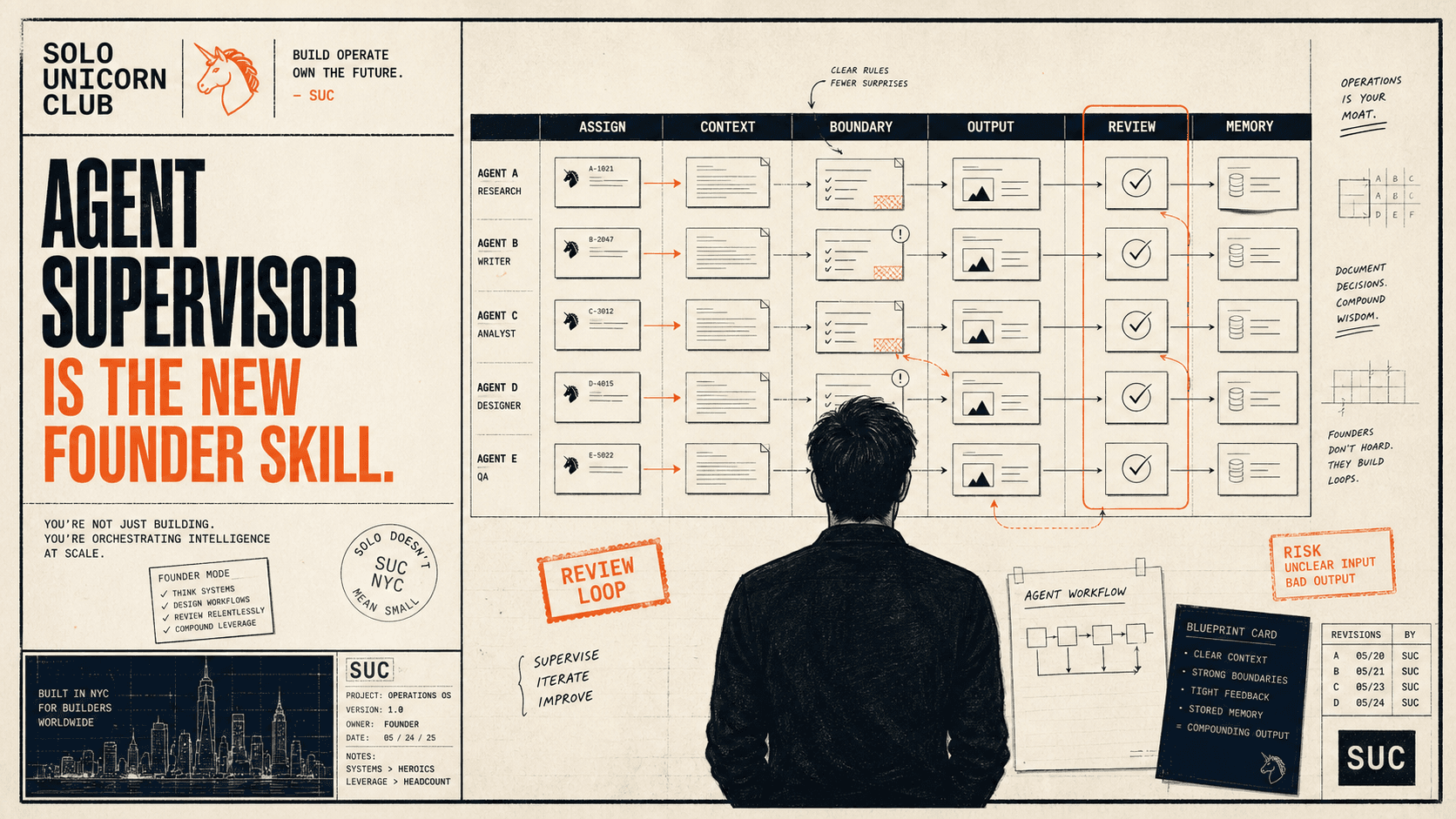
I use a simple loop for every AI agent workflow:
- Assign
- Context
- Boundary
- Output
- Review
- Memory
If any step is missing, the workflow gets unreliable.
Step 1: Assign
Do not start with a vague task. Start with the role and the decision you need.
Bad:
Research AI SEO.
Better:
Act as the Growth Research Agent for Solo Unicorn Club. Find current signals around AI SEO and Generative Engine Optimization for solo AI founders. Focus on evidence that can support an English blog article designed to attract builders, founders, and AI operators in New York. Return only sources, claims, and implications.
The role changes the output.
Step 2: Context
AI agents are only as good as the context they receive.
For a solo founder, company context should include:
- what the company does
- who the customer is
- what the brand voice sounds like
- what metrics matter
- what has already been tried
- what must not be changed
- what the founder personally believes
Most bad AI output is not caused by weak intelligence. It is caused by missing context.
Step 3: Boundary
Every agent needs a permission boundary.
For example:
- The Research Agent may browse and summarize, but may not invent sources.
- The Growth Agent may draft, but may not publish.
- The Sales Agent may personalize emails, but may not send them.
- The Engineering Agent may edit code, but may not deploy without tests.
- The Finance Agent may classify expenses, but may not move money.
- The Legal Agent may flag risks, but may not make final legal decisions.
Boundaries are not bureaucracy. They are how a one-person company stays fast without becoming reckless.
Step 4: Output
The output format matters more than people think.
If an agent gives you a beautiful paragraph, you have to read slowly. If it gives you a decision table, uncertainty level, source list, and next action, you can review quickly.
For each recurring agent, define the artifact.
Research Agent:
- top 5 signals
- source link
- why it matters
- confidence level
- suggested use
Engineering Agent:
- changed files
- tests run
- risks
- rollback plan
- unanswered questions
Growth Agent:
- search intent
- target keywords
- article outline
- draft
- FAQ
- internal links
Output design is supervision design.
Step 5: Review
The most dangerous moment is when an agent output looks polished.
Polish creates false trust.
My review checklist asks:
- Is the source real?
- Is the claim specific?
- Does this match what I know about the customer?
- Is there a hidden assumption?
- What would break if this were wrong?
- Does the output need human taste, empathy, or accountability?
The last question is the most important. If the answer is yes, I stay involved.
Step 6: Memory
After review, the lesson needs to go somewhere.
If an agent repeatedly makes the same mistake and you only correct it in chat, you are training yourself to babysit. If the correction becomes a prompt rule, checklist item, or company memory, the system improves.
Every failure should become one of these:
- a better prompt
- a better source
- a better template
- a better permission rule
- a better review checklist
- a better product decision
That is how an AI workflow compounds.
The Five Mistakes New Agent Supervisors Make
Mistake 1: Delegating Decisions Instead of Execution
Agents are good at preparing decisions. They are not the founder.
Do not ask, "What should my company do?"
Ask:
Prepare three strategic options, list the evidence for each, identify risks, and recommend what additional information I need before deciding.
That keeps judgment where it belongs.
Mistake 2: Giving Every Agent Too Much Access
An agent with full access to your inbox, codebase, CRM, payment tools, and publishing system is not leverage. It is an incident waiting to happen.
Start with read-only. Add write access only after the workflow is stable.
Mistake 3: Reviewing Too Late
If you review only at the final output, you may discover the agent went in the wrong direction an hour ago.
For high-stakes work, review the outline or plan first. Then let the agent execute.
Mistake 4: Treating AI Errors as Random
Some errors are random. Many are systemic.
If your content agent sounds generic, it lacks voice examples.
If your research agent hallucinates, it lacks source rules.
If your coding agent breaks flows, it lacks acceptance criteria.
If your sales agent writes cringe outreach, it lacks customer language.
Do not just correct the output. Fix the system.
Mistake 5: Measuring Hours Saved Instead of Judgment Preserved
Saving time is nice. Preserving founder judgment is better.
The goal is not to remove yourself from the company. The goal is to remove yourself from low-leverage execution so you can spend more time on customers, product, community, and strategy.
The Agent Supervisor Scorecard
Here is a simple way to evaluate whether a workflow is ready for more autonomy.
Score each item from 1 to 5:
- The task repeats often.
- The input data is clear.
- The output format is standardized.
- Mistakes are easy to detect.
- Mistakes are low-risk or reversible.
- The agent has enough company context.
- The review checklist is fast.
- The workflow has succeeded at least five times manually.
If the total is below 25, keep it manual.
If it is 25 to 34, use assisted automation.
If it is 35 or above, consider scheduled automation with human review.
This keeps you from automating chaos.
What This Means for Solo Founders
A one-person company used to be constrained by the founder's personal execution capacity.
Now the constraint is different.
The constraint is how many workflows the founder can design, supervise, and improve without losing quality.
That is why the best solo AI founders I know are becoming operators of systems, not just users of tools. They write better briefs. They maintain better company memory. They define sharper review gates. They know which tasks can be delegated and which require human presence.
In a New York AI community, this becomes even more valuable because the opportunities are diverse. One week you may be evaluating an AI workflow for luxury retail. The next week it is legal ops, finance, real estate, media, or education. You cannot personally become an expert in every workflow overnight.
But you can build agents that research, summarize, draft, compare, and prepare the work so your human judgment travels further.
FAQ: Agent Supervisor
What is an Agent Supervisor?
An Agent Supervisor is a founder or operator who assigns work to AI agents, provides context, defines permission boundaries, reviews outputs, and turns mistakes into better workflows.
Is Agent Supervisor a real job?
It is becoming a real operating role. In a one-person company, the founder usually plays this role. In larger companies, it may become part of operations, product, engineering, marketing, or customer success.
What skills does an Agent Supervisor need?
The core skills are task design, context management, quality review, risk assessment, and workflow documentation. Prompting helps, but supervision is broader than prompting.
Can AI agents run without supervision?
Some low-risk workflows can run with light supervision after testing. High-stakes workflows involving customers, money, code deployment, legal decisions, or brand reputation still need human review.
One Sentence Summary
AI agents make execution cheaper, but they make founder judgment more important.
The solo founder who learns to supervise agents will outproduce the founder who only learns to prompt them.
Sources and signals worth reading: Stanford 2026 AI Index, Anthropic Economic Index, OpenAI Codex, and McKinsey State of AI.