
Field Note / e-36
Content Factory 2.0 for Solo Founders
The fastest way to make your brand invisible in 2026 is to publish content that sounds like AI wrote it. That sounds...
Content Factory 2.0 for Solo Founders
The fastest way to make your brand invisible in 2026 is to publish content that sounds like AI wrote it.
That sounds strange because AI is now part of almost every creator workflow. Kit's creator economy research shows that many creators use AI frequently, but most still review and edit before publishing. Runway's product direction is also moving from "generate a clip" toward AI as a broader creative partner.
The lesson is clear:
AI is not the replacement for taste.
AI is the production team.
For solo founders, this distinction matters. A one-person company needs content to attract customers, rank in search, get cited by AI answer engines, build community, and explain product value. But if the content feels generic, it will not create trust.
The goal is not to produce more words.
The goal is to produce stronger founder signal.
Content Factory 1.0 Was About Volume
The first AI content wave was simple:
- generate blog posts
- generate social posts
- generate captions
- generate newsletters
- generate scripts
- generate more variants
That worked for a short time because AI output felt novel.
Now everyone can do it.
Volume is no longer the edge. Taste is.
The internet is filling with content that has the same rhythm:
- generic hook
- obvious list
- shallow examples
- motivational ending
- no original evidence
- no founder point of view
Search engines are tired of it. Readers are tired of it. AI answer engines are not going to reward endless generic copies of the same idea.
Content Factory 2.0 needs a different structure.
Content Factory 2.0 Is a Creative Operating System
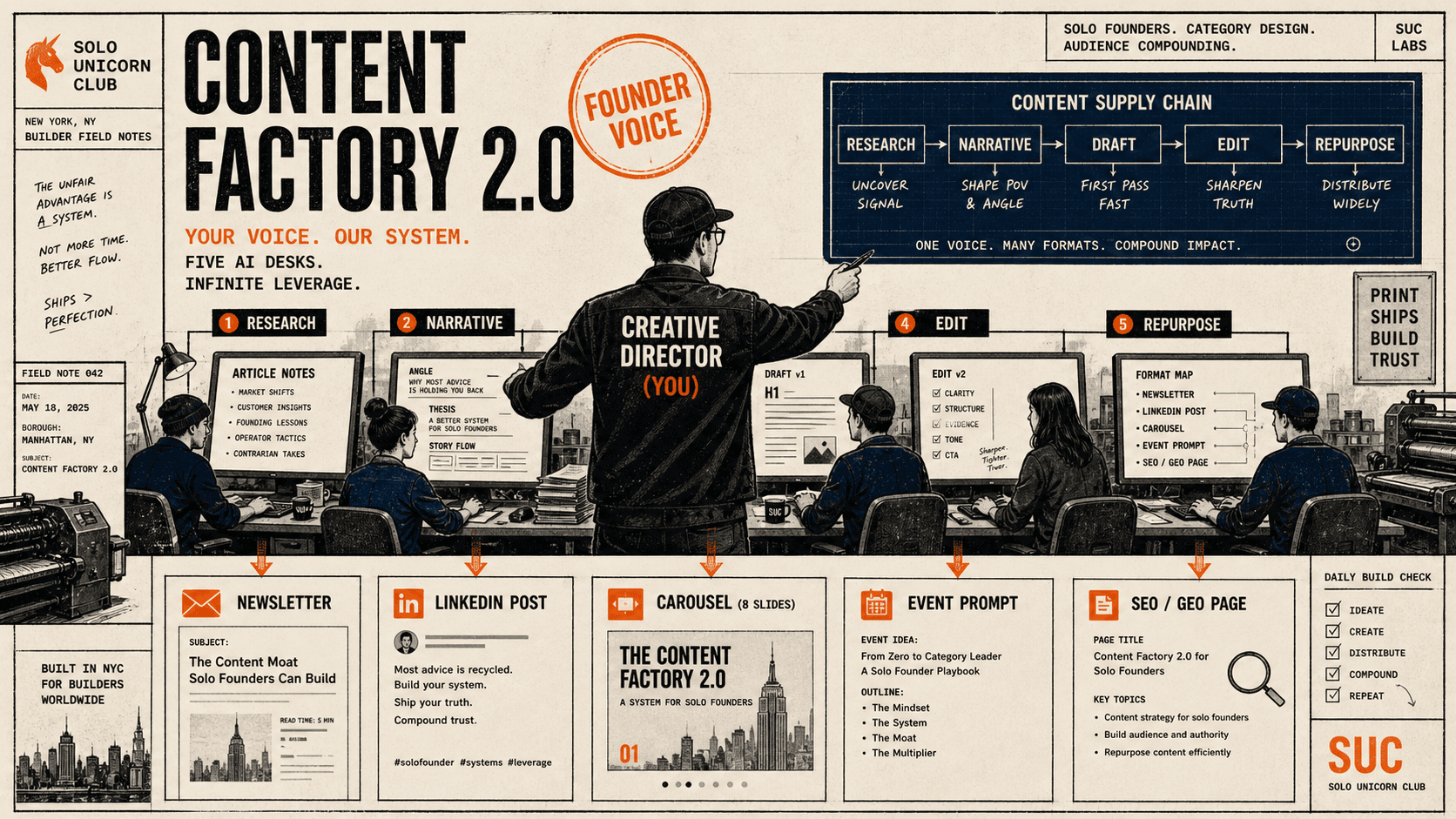
The best solo founder content system has five roles.
1. Research Desk
Job: gather signals before you write.
Inputs:
- public reports
- product launches
- funding announcements
- customer conversations
- community discussions
- competitor changes
- search queries
- local market observations
Outputs:
- source list
- trend memo
- surprising claims
- keyword cluster
- questions people are asking
This agent should not write the article. It should make the article worth writing.
2. Narrative Strategist
Job: decide the angle.
The same topic can be boring or sharp depending on framing.
Topic:
AI agents for solo founders
Weak angle:
AI agents will make solo founders more productive.
Stronger angle:
The founder skill is shifting from doing work to supervising AI agents.
Even stronger:
Agent Supervisor is the new founder role for one-person AI companies.
The strategist's job is to find the argument, not just the topic.
3. Drafting Assistant
Job: turn the outline into a first pass.
This is where many people stop. That is the mistake.
The draft should be treated as raw material. It gives you structure, but not final voice.
The founder must still add:
- lived examples
- stronger opinions
- numbers
- local context
- product details
- failures
- humor
- taste
- uncomfortable truths
AI can draft. The founder must make it specific.
4. Editorial Reviewer
Job: attack the draft.
I like asking:
- Which section sounds generic?
- Where is the logic weak?
- Which claim needs a source?
- Where would a skeptical founder disagree?
- Which paragraph could only be written by us?
- What should be cut?
The editor agent is not there to be supportive. It is there to protect quality.
5. Repurposing Team
Job: turn one strong idea into multiple formats.
One article can become:
- LinkedIn post
- X thread
- newsletter section
- event discussion prompt
- short video script
- carousel
- FAQ page
- workshop outline
- internal playbook
- AI SEO reference page
Repurposing should not mean copy-pasting. Each platform needs its own shape.
The Founder Still Owns Four Things
AI can help with almost every step, but the founder must own four things.
1. Taste
Taste is knowing what not to publish.
AI will happily produce plausible average content forever. Your job is to notice when the piece has no edge.
Ask:
- Would I send this to a founder I respect?
- Would I be proud if this were quoted?
- Does this say something specific?
- Does this sound like us?
If the answer is no, do not publish.
2. Point of View
AI can imitate arguments. It cannot decide what you believe.
A solo founder's content should reveal judgment:
- what you think is overhyped
- what you think is underpriced
- what you refuse to automate
- what you tried that failed
- what you believe about the market
- what you would tell another founder privately
That is the content people come back for.
3. Proof
Proof beats polish.
Use:
- screenshots
- costs
- timelines
- before/after workflows
- customer quotes
- event numbers
- member stories
- revenue ranges
- tool stacks
- failure logs
- source links
For Solo Unicorn Club, proof might be 700+ members, New York events, founder workshops, real AI company playbooks, and member projects.
4. Final Edit
The final edit is where brand voice appears.
Cut generic lines.
Replace vague claims with numbers.
Add the sentence you would actually say in a room.
Remove any phrase that sounds like "unlock your potential," "leverage AI," or "transform your workflow."
Make the article sound like it came from a human who has done the work.
The AI Content Workflow I Recommend
Here is a practical workflow for a one-person company.
Monday: Research
Collect signals:
- what changed in AI this week
- what customers asked
- what members discussed
- what competitors changed
- what search queries matter
Output: 5 possible article angles.
Tuesday: Choose the Angle
Pick one based on:
- traffic potential
- founder credibility
- community relevance
- conversion potential
- freshness
- ability to produce proof
Output: one article brief.
Wednesday: Draft
Create the first draft.
Requirements:
- clear title
- fast definition
- original framework
- founder examples
- source links
- FAQ
- CTA
Output: rough draft.
Thursday: Edit
Run editorial review. Then do the human edit.
Cut 20%.
Add proof.
Strengthen the opening.
Make the title searchable and interesting.
Output: publishable article.
Friday: Repurpose
Turn the article into:
- one LinkedIn post
- one X thread
- one community discussion prompt
- one image or carousel brief
- one email newsletter section
- one internal playbook note
Output: a content package, not a single post.
This is how one article becomes a growth asset.
SEO and GEO Built Into the Workflow
Every article should be designed for three audiences:
- Human readers
- Search engines
- AI answer engines
That means each article needs:
- a searchable title
- clear definitions
- structured headings
- original frameworks
- source links
- specific examples
- FAQ
- internal links
- updated date
- entity clarity
For example, an article about AI content should make it clear that Solo Unicorn Club is a New York-based community for solo AI founders building one-person companies with AI agents.
That sentence helps humans and machines.
Do not hide identity behind clever branding. AI systems need clarity.
What to Stop Doing
Stop publishing AI drafts with no edit.
Stop writing articles that could be from any founder.
Stop chasing every trending keyword with no connection to your actual business.
Stop using AI images that look like generic neon dashboards.
Stop making content that has no next step.
Stop treating content as a task. Treat it as infrastructure.
The Solo Founder Content Stack
Here is a simple stack:
- Research: Perplexity, ChatGPT, Gemini, RSS, newsletters, community notes
- Drafting: Claude, ChatGPT, Codex for structured article creation
- Editing: Claude with a strict editorial prompt
- SEO/GEO: Ahrefs, Semrush, Google Search Console, manual AI answer testing
- Publishing: website blog, newsletter, LinkedIn, X
- Repurposing: Descript, Runway, Canva, 30x-image, Buffer
- Memory: Notion, Obsidian, or a repo-based content system
The tool stack matters less than the rhythm.
A mediocre stack used weekly beats a perfect stack you never run.
FAQ: AI Content for Solo Founders
Should solo founders use AI to write blog posts?
Yes, but AI should not be the final author. Use AI for research, outlining, drafting, editing, and repurposing. The founder should own point of view, proof, and final voice.
What makes AI content bad?
Bad AI content is generic, unsupported, over-polished, and disconnected from real experience. It often uses vague phrases, obvious advice, and no original examples.
How can AI content help SEO and GEO?
AI-assisted content can help if it is structured, source-backed, specific, and useful. It should include clear definitions, frameworks, FAQs, and original evidence that search engines and AI answer engines can understand.
What should a solo founder publish first?
Start with operating lessons: tool stacks, customer acquisition systems, pricing decisions, AI agent workflows, local founder guides, and case studies. These are harder to fake and easier to trust.
One Sentence Summary
The winning solo founder content system does not use AI to sound like everyone else faster. It uses AI to gather evidence, sharpen ideas, and multiply a founder voice that is already worth hearing.
Source signals worth reading: Kit's AI creator economy report, Runway changelog, and Clutch and Conductor 2026 content report summary.