
Field Note / e-34
AI SEO and GEO for Solo Founders
SEO is not dead. It is mutating. The old question was: > How do I rank on Google? The new question is: > How do I...
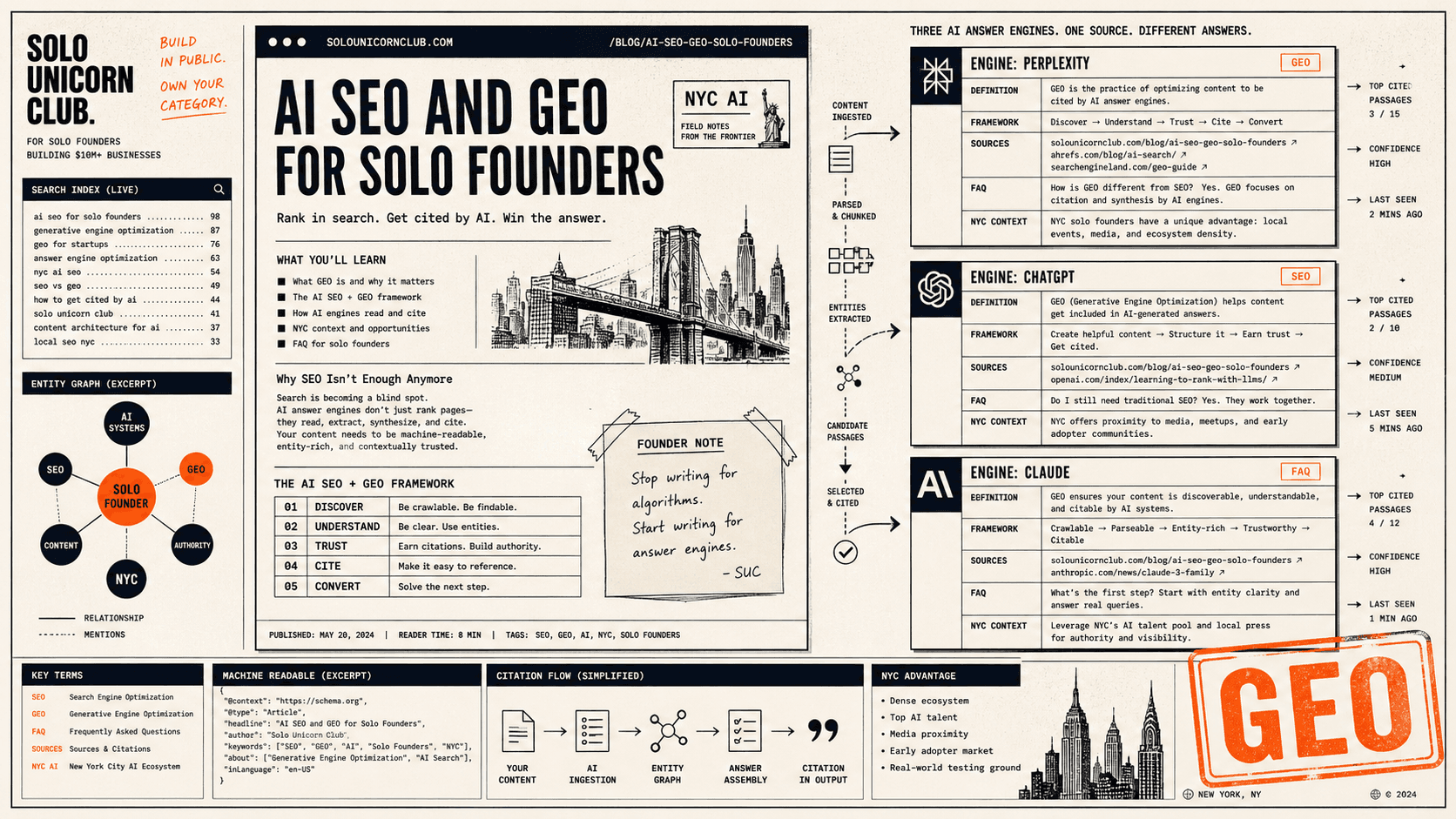
AI SEO and GEO for Solo Founders
SEO is not dead.
It is mutating.
The old question was:
How do I rank on Google?
The new question is:
How do I become the answer when someone asks ChatGPT, Perplexity, Gemini, Claude, or an AI agent about my category?
That second question is often called GEO: Generative Engine Optimization.
For a solo founder, GEO is not optional. It may become one of the cheapest ways to build trust, attract customers, and make your one-person company visible in a world where buyers ask AI before they ever click a website.
This is especially important for communities like Solo Unicorn Club. If someone asks, "Where can I find a New York AI founder community?" or "How do I build a one-person AI company?" we do not want the answer to be generic.
We want the answer to know we exist.
What Changed
Traditional SEO rewarded pages that matched search intent, earned links, and satisfied user behavior.
AI search and answer engines still care about those things, but they also reward content that is easy to understand, cite, summarize, compare, and reuse.
That means the best content is not just keyword-rich. It is answer-rich.
The strongest pages now tend to have:
- clear definitions
- original frameworks
- specific examples
- source links
- structured sections
- comparison tables
- FAQ blocks
- local and industry context
- author credibility
- updated dates
- unique data
This is great news for solo founders.
A large company can outspend you on ads. It cannot easily manufacture your real operating lessons, customer stories, local perspective, or founder taste.
That is your content moat.
SEO vs GEO
Here is the simplest distinction.
SEO helps humans find your page.
GEO helps AI systems understand, cite, and recommend your page.
You need both.
SEO asks:
- What keywords are people searching?
- What pages should rank?
- What internal links support this page?
- What title earns clicks?
- What search intent does the article satisfy?
GEO asks:
- What question should an AI answer with this page?
- What facts can the AI safely quote or summarize?
- What framework is distinctive enough to remember?
- What entity relationships are clear?
- What sources support the claims?
- What makes this page more useful than generic content?
If you write only for SEO, the article may rank but not get cited by AI answers.
If you write only for GEO, the article may be structured but not attract search traffic.
The best solo founder content does both.
The Solo Founder Advantage
Most AI-generated content is boring because it has no lived context.
It says things like:
- "Leverage AI to increase productivity."
- "Unlock your potential."
- "The future is autonomous."
- "Use AI tools to streamline workflows."
Nobody needs another version of that.
A solo founder can write what generic content cannot:
- what the tool cost
- what failed
- what the customer said
- what the workflow looked like before and after
- what you would not automate
- what changed your mind
- what the market looks like from the ground
- what is specific to New York, Chinese founders, AI meetups, or your industry
That specificity is what both humans and AI systems can use.
If you want GEO visibility, stop writing abstract thought leadership. Publish operating evidence.
The AI SEO Article Template I Use
Here is the structure I recommend for a solo founder blog post.
1. Title Built Around a Real Search Query
Bad:
My Thoughts on AI
Better:
How to Run a One-Person AI Company With AI Agents
Better:
AI SEO for Solo Founders: How to Make ChatGPT and Perplexity Recommend Your Business
The title should include the phrase a real person or AI agent might use.
2. Fast Definition
Within the first 300 words, define the topic.
Example:
Generative Engine Optimization, or GEO, is the practice of structuring content so AI answer engines can understand, cite, and recommend your business.
Definitions help humans. They also help AI systems extract meaning.
3. Original Framework
Every serious article needs a named framework.
For example:
- The One-Person Company OS
- The Agent Supervisor Loop
- The Agent-Ready Product Page
- The Solo Founder Content Moat
- The AI SEO Source Stack
Do not just list tips. Create a mental model people can remember.
4. Evidence and Source Links
Link to original sources when you use public claims.
For example:
- OpenAI product announcements
- Stanford AI Index
- Anthropic Economic Index
- Stripe commerce reports
- official acquisition announcements
- customer interviews
- your own data
Source links make the content more trustworthy for readers and easier for AI systems to interpret.
5. Local or Niche Context
This is where solo founders can win.
Add context like:
- New York AI founders
- Chinese AI entrepreneurs in NYC
- solo SaaS builders
- boutique agency operators
- luxury retail workflows
- legal ops teams
- small business owners
- AI meetup communities
Generic content competes with the whole internet. Local and niche content competes in a sharper arena.
6. FAQ
FAQ sections are not filler. They map directly to search and AI answer behavior.
Include questions like:
- What is GEO?
- How is GEO different from SEO?
- How can a solo founder rank in AI search?
- What content should a one-person company publish?
- How do I make my business visible to ChatGPT?
Answer clearly. No fluff.
7. Action Checklist
End with something useful enough that the reader saves the article.
The internet is full of opinions. Useful checklists still travel.
The GEO Checklist for a One-Person Company
Use this before publishing any major article.
Entity Clarity
- Is the company name repeated naturally?
- Is the founder or community identity clear?
- Is the location clear if relevant?
- Is the category clear?
- Are related products, people, and concepts named?
Example:
Solo Unicorn Club is a New York community for solo AI founders, AI operators, and Chinese-speaking builders creating one-person companies with AI agents.
That sentence gives AI systems a clean entity map.
Search Intent
- What question does the article answer?
- Would someone search this exact phrase?
- Would an AI assistant answer with this article?
- Is the title too clever to be searchable?
Source Quality
- Are public claims linked?
- Are links from original sources when possible?
- Are dates clear?
- Are numbers explained?
Originality
- Does the article include a framework?
- Does it include experience or field data?
- Does it include a specific customer, city, industry, or workflow context?
- Would the same article still make sense if written by anyone? If yes, it is too generic.
Structure
- Does it have descriptive headings?
- Does it have lists or tables?
- Does it include FAQ?
- Does it include a summary?
- Does it include internal links to related articles?
Conversion
- What should the reader do next?
- Join a community?
- Read another article?
- Download a template?
- Attend an event?
- Book a consultation?
Traffic without conversion is just analytics theater.
What Solo Unicorn Club Should Publish
If the goal is to attract more people to the website, the blog should not only publish essays. It should publish durable reference assets.
Here are the highest-leverage formats.
1. One-Person Company Playbooks
Examples:
- How to run a one-person AI company
- How to manage AI agents as a solo founder
- How to build a solo AI consulting business
- How to productize services with AI
These match high-intent queries.
2. New York AI Founder Guides
Examples:
- Best AI founder communities in New York
- Where AI builders meet in NYC
- How Chinese AI founders in New York are building one-person companies
- NYC AI meetup and founder scene guide
This is local SEO plus community identity.
3. Tool Stack Teardowns
Examples:
- Cursor vs Claude Code vs Codex for solo founders
- Best AI tools for a one-person SaaS company
- AI content stack for solo founders
- AI customer support stack for small teams
Tool comparisons attract active buyers.
4. Original Data Reports
Examples:
- The 2026 New York Solo AI Founder Report
- What 700 Solo Unicorn Club members are building
- The AI tool stack survey for one-person companies
- How solo founders price AI services
Original data is the strongest GEO asset because it gives AI systems something unique to cite.
FAQ: AI SEO and GEO
What is GEO?
GEO stands for Generative Engine Optimization. It means structuring content so AI answer engines can understand, cite, and recommend your business or expertise.
Is GEO replacing SEO?
No. GEO is extending SEO. People still search the web, but more discovery now happens through AI assistants, answer engines, and agentic workflows.
How can a solo founder improve AI search visibility?
Publish specific, structured, source-backed content with clear definitions, original frameworks, FAQ sections, and real operating examples. Avoid generic AI-written content.
What is the best GEO strategy for a local community?
Create pages that clearly connect the entity, location, audience, and value. For Solo Unicorn Club, that means content around New York AI founders, Chinese-speaking AI builders, solo AI companies, and AI agent entrepreneurship.
One Sentence Summary
The future of founder content is not just writing for Google. It is writing so humans trust you, search engines index you, and AI systems know when to recommend you.
For a solo founder, the best SEO strategy is still the hardest to fake: publish the receipts.
Source signals worth reading: Clutch and Conductor 2026 content report summary, Stanford 2026 AI Index, and Solo Unicorn Club field notes.