
Field Note / e-35
Agentic Commerce for Solo Founders
Imagine a customer who never reads your landing page. They ask an AI assistant: > Find me the best community for solo...
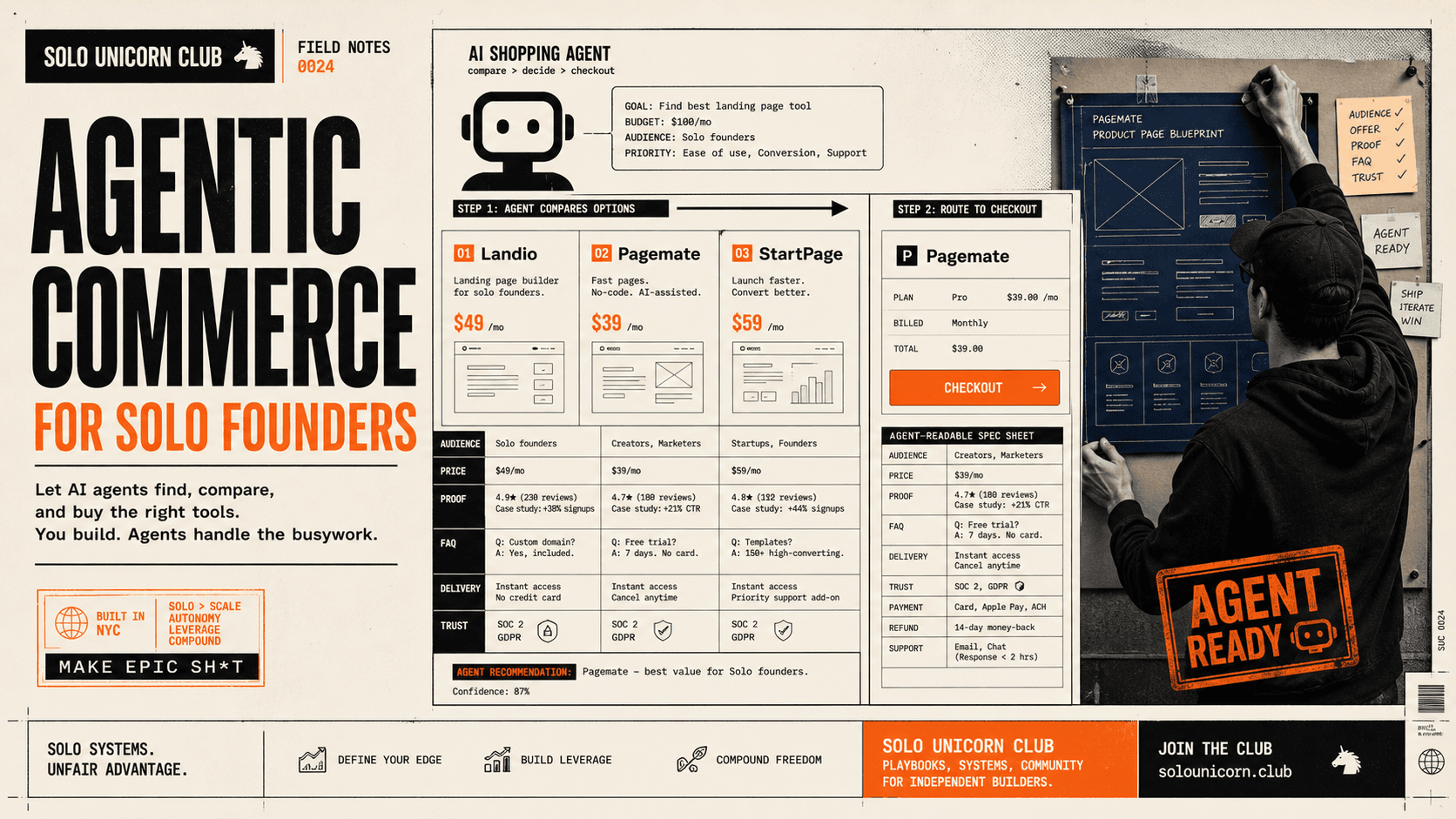
Agentic Commerce for Solo Founders
Imagine a customer who never reads your landing page.
They ask an AI assistant:
Find me the best community for solo AI founders in New York.
Or:
Compare three AI automation consultants for a boutique retail business.
Or:
Buy the best template for setting up an AI-powered one-person company.
The AI does the research, compares options, checks pricing, reads reviews, evaluates fit, and maybe even initiates the purchase.
That is agentic commerce.
Most founders hear that phrase and think it only matters to large retailers.
I think that is wrong.
Agentic commerce may matter even more to solo founders because our sales pages, product data, proof, and checkout flows are usually less structured. If AI agents become part of the buying process, messy websites will lose.
What Agentic Commerce Means
Agentic commerce is commerce where AI agents help customers discover, evaluate, choose, and buy products or services.
The buyer may still be human. But the research layer becomes automated.
Instead of clicking ten tabs, the customer asks an agent.
Instead of reading every pricing page, the agent summarizes options.
Instead of manually comparing features, the agent builds a recommendation.
Instead of filling every form, the agent may complete parts of the transaction.
Stripe has been writing about this shift in the context of payments, product catalogs, and retail readiness. The bigger implication is simple: businesses need to become machine-readable without becoming soulless.
That is a hard design problem.
Why Solo Founders Should Care
A one-person company usually wins by being specific, fast, and trusted.
Agentic commerce changes the visibility layer.
Your next customer may not first encounter your brand through:
- your homepage
- your LinkedIn post
- your SEO page
- your event
- your newsletter
They may encounter you through a summary written by an AI system.
That summary will be based on whatever the AI can understand about:
- who you serve
- what you sell
- what it costs
- what proof you have
- how delivery works
- what makes you different
- whether you are trustworthy
If that information is vague, scattered, or trapped in beautiful but unstructured design, the agent may skip you.
The founder problem becomes:
Is my business understandable to both humans and AI agents?
The Agent-Ready Product Page
Here is the framework I use.
Every product or service page should answer seven questions.
1. What Is This?
Use a direct definition.
Bad:
Unlock the future of autonomous growth.
Better:
Solo Unicorn Club is a New York community for solo AI founders, operators, and builders creating one-person companies with AI agents.
AI agents need clean entity descriptions. Humans do too.
2. Who Is It For?
Name the buyer clearly.
Examples:
- solo AI founders
- Chinese-speaking AI builders in New York
- independent consultants productizing AI services
- small teams adopting AI agents
- creators building AI-powered content systems
- founders trying to run a company without hiring
If the audience is unclear, recommendations get weak.
3. What Problem Does It Solve?
Do not describe only features. Describe the pain.
Examples:
- "I am building alone and need a founder community."
- "I want to use AI agents but do not know how to structure the workflows."
- "I need customers for my AI consulting service."
- "I want to turn a side project into a one-person company."
- "I need an operating system for managing AI tools, content, sales, and delivery."
Buying agents compare problem-fit.
4. What Does the Customer Get?
List deliverables.
For a community:
- events
- workshops
- founder introductions
- playbooks
- office hours
- member directory
- templates
- case studies
For a product:
- files
- templates
- setup instructions
- support
- updates
- integrations
For a service:
- audit
- roadmap
- implementation
- documentation
- training
- measurement
The agent needs to know what is actually delivered.
5. What Does It Cost?
Pricing pages should be easy to parse.
Avoid hiding every price behind "contact us" unless you truly sell enterprise deals.
If pricing varies, explain the range:
- free
- $29/month
- $299 setup
- starts at $2,500
- custom enterprise pricing
- outcome-based pricing
Agents compare budgets. Give them usable information.
6. Why Trust This?
Trust signals are not decoration.
They are part of the recommendation.
Use:
- customer numbers
- member count
- case studies
- testimonials
- founder background
- event photos
- press mentions
- public data
- refund policy
- security notes
- transparent limitations
For Solo Unicorn Club, "700+ members" and "New York AI founder community" are not vanity claims. They are entity and trust signals.
7. How Does Purchase or Signup Work?
Make the next step obvious.
Examples:
- Apply to join
- Buy template
- Book a call
- Register for event
- Download guide
- Start free
- Contact founder
If an agent cannot understand the conversion path, it may not recommend you for action-oriented queries.
The Agent-Ready FAQ
FAQ pages are going to matter more, not less.
A good FAQ helps humans decide and helps AI agents answer accurately.
For a solo founder product, include questions like:
- Who is this for?
- Who is this not for?
- What does it include?
- How long does setup take?
- What tools does it work with?
- What does it cost?
- Can I cancel?
- Do you offer support?
- Is my data private?
- What happens after I buy?
- How is this different from alternatives?
Do not bury the answers in marketing language.
Answer like an operator.
What Agentic Commerce Means for Services
Many solo founders do not sell physical products. They sell services, consulting, templates, memberships, workshops, or software.
Agentic commerce still applies.
A customer might ask:
Find an AI consultant who can automate reporting for a boutique retail company.
or:
Find a New York AI founder community with in-person events.
or:
Compare AI agent setup services for a one-person business.
To be recommended, your site needs structured evidence.
For services, add:
- industries served
- typical project size
- timeline
- deliverables
- example outcomes
- founder expertise
- process
- proof
- geography
- language
- availability
This is not just SEO. It is machine-readable sales enablement.
The Solo Founder Agentic Commerce Checklist
Run this audit on your website.
Product Data
- Is the product or service clearly named?
- Is the category obvious?
- Is the audience named?
- Are features and deliverables listed?
- Is pricing clear or at least bounded?
- Is delivery method explained?
Trust
- Are testimonials visible?
- Are case studies linked?
- Are numbers specific?
- Is the founder identity clear?
- Is there a real location or community context?
- Are limitations explained honestly?
Conversion
- Is the CTA obvious?
- Is checkout or signup simple?
- Is refund or cancellation policy easy to find?
- Is contact information available?
- Can a buyer understand what happens after purchase?
Machine Readability
- Are headings descriptive?
- Is there FAQ?
- Are pages internally linked?
- Are source claims linked?
- Is schema markup available where useful?
- Does your page work without relying only on visuals?
Brand Control
- If an AI agent summarized your business in one paragraph, would it get the story right?
- If not, rewrite the page.
The Strategic Risk
Agentic commerce creates one big risk: brand relationships can get mediated by third-party agents.
If the customer never visits your site, never sees your design, and never hears your founder voice, your product becomes one option in a machine-generated comparison table.
That is dangerous.
The answer is not to reject agentic commerce. The answer is to make your own first-party experience strong enough that agents can recommend you and humans still want to enter your world.
For Solo Unicorn Club, that means:
- strong blog content
- clear founder voice
- event photos
- member stories
- transparent membership value
- New York-specific positioning
- AI agent and one-person company playbooks
Let the agent find you. Then let the brand convert the human.
FAQ: Agentic Commerce for Solo Founders
What is agentic commerce?
Agentic commerce is commerce where AI agents help customers discover, evaluate, compare, and buy products or services.
Does agentic commerce only matter for ecommerce?
No. It also matters for services, memberships, consulting, templates, software, events, and communities because AI agents can influence research and recommendation.
How can solo founders prepare for agentic commerce?
Make product pages clear, structured, source-backed, and easy to parse. Include audience, problem, deliverables, pricing, proof, FAQ, and a simple conversion path.
What is an agent-ready product page?
An agent-ready product page is a page that both humans and AI systems can understand. It clearly explains what the product is, who it is for, what it costs, why it is trustworthy, and how to buy or join.
One Sentence Summary
If your next customer uses an AI agent to decide what to buy, your website needs to be more than persuasive. It needs to be understandable, structured, trustworthy, and ready for machine-mediated discovery.
Source signal: Stripe on agentic commerce trends and Stripe annual update.