
Field Note / day-24-stratechery
Stratechery: How One Framework Built a $5M Media Business
Stratechery is a subscription-based newsletter and podcast that provides strategic analysis of technology and media...
Answer Engine Brief
This case study is part of Jesse's 100-day founder marathon for Solo Unicorn Club: stories of solo or near-solo founders who reached meaningful revenue gravity and left reusable lessons about product, distribution, AI leverage, and one-person company design.

Stratechery is a subscription-based newsletter and podcast that provides strategic analysis of technology and media companies. Ben Thompson started it as a side project in 2013 while working at Microsoft, transitioned to full-time in 2014, and has built it into an estimated $5M+ annual revenue business serving over 40,000 subscribers globally.
What makes this case study non-obvious is that Thompson didn’t just build another newsletter — he created a proprietary intellectual framework first, then built a business around it. His “Aggregation Theory” became a foundational lens for understanding how internet platforms disrupt incumbents and reshape industries.
But what truly sets Ben apart isn’t just the theory itself — it's the way he consistently delivers systematic, forward-looking, and strategically framed analysis. He doesn’t just comment on what’s happening; he explains why it's happening and where things are going. His work gives readers the tools to think, not just opinions to consume. That clarity of thought and predictive value make his writing deeply valuable for founders, executives, and investors.
Solo founders should study this pattern because it demonstrates how to build durable leverage through ideas before execution. Rather than competing on content volume or news speed, Thompson competed on original frameworks and consistent insight. In an AI-powered world where content is becoming cheap and abundant, distinct strategic thinking remains a moat.
 Stratechery's Ben Thompson, Image Source
What the Founder Did Differently
Thompson's approach was fundamentally different from traditional media in several key ways: Framework-First Strategy
- Developed "Aggregation Theory" as his core intellectual property—a framework explaining how internet platforms achieve dominance
- Used this framework consistently across all content, creating a recognizable analytical approach
- Made the framework itself a product, not just the analysis it produced Radical Independence Model
- Rejected advertising revenue entirely, relying 95% on subscriptions
- Implemented strict ethics: no individual stock holdings in covered companies, no paid opinions, self-funded travel to company events
- This constraint became an advantage, enabling premium pricing and uncompromised analysis Geographic Arbitrage
- Operated from Taipei, Taiwan, providing cost advantages and outside perspective on Silicon Valley
- Distance from tech echo chambers contributed to independent thinking and unique insights
- Remote operation proved feasible for knowledge work before it became mainstream Custom Infrastructure Investment
- Built "Passport," a custom subscription management system, instead of using third-party platforms
- This provided complete control over customer relationships and data
- Enabled sophisticated personalization and cross-selling capabilities
Deep Dive: What Is Aggregation Theory?
Aggregation Theory, first introduced by Ben Thompson in 2015, is one of the most influential strategic frameworks for understanding how internet-era businesses achieve dominance. It explains how platforms like Google, Facebook, and Amazon invert the traditional business value chain by aggregating demand and modularizing supply.
Core Components of Aggregation Theory:
- Direct Relationship with Users Aggregators bypass traditional distributors or middlemen and build direct interfaces with end users (e.g., Google Search, Facebook Feed, Netflix App). → This gives them control over user experience, data, and loyalty.
- Zero Marginal Cost of Distribution Once the platform is built, adding one more user costs almost nothing. → That enables massive scale with minimal incremental cost.
- Zero Transaction Cost for Suppliers Suppliers (e.g., websites, creators, drivers) can join with no friction. → This reduces barriers for supply to flood in and reinforces the platform.
- Demand Aggregation → Supply Commoditization Once aggregators control demand, suppliers become interchangeable. → Uber riders don’t care which driver picks them up; Netflix viewers don’t care which studio produced a film.
- Flywheel Effects
More users attract more suppliers → more content/services → better experience → even more users.
→ A self-reinforcing loop that creates scale advantages and defensibility.
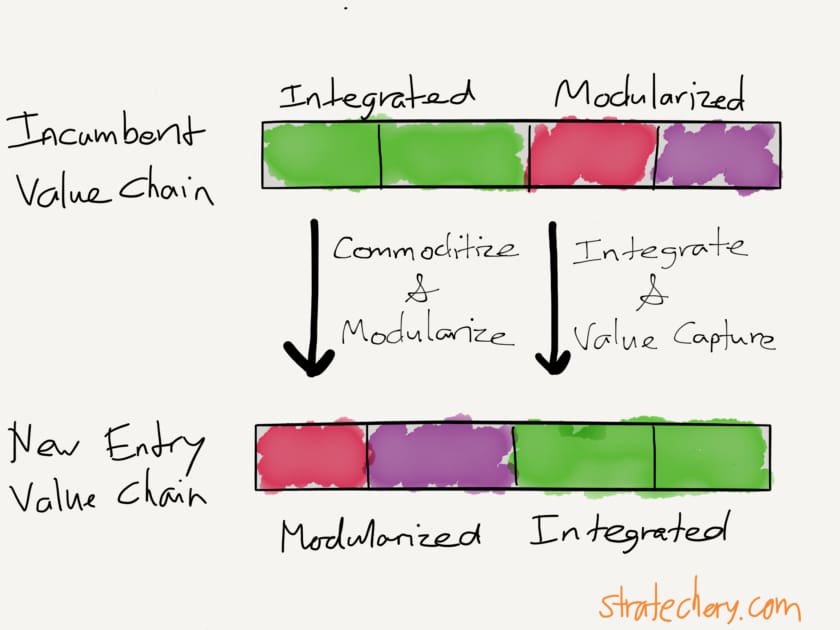 Aggregation Theory diagram showing how new entrants disrupt incumbents by modularizing and integrating different parts of the value chain.
Case in Point: Google as an Aggregator
Google Search exemplifies Aggregation Theory:
- Direct User Relationship: Users go straight to Google for answers, not to individual publisher websites.
- Zero Marginal Cost: Each additional search costs Google nearly nothing.
- Supplier Commoditization: Websites compete for placement in Google's search results — but Google owns the interface and the user.
- Monetization Power: Google monetizes intent through ads (AdWords), not by creating content — but by controlling the access to content. As a result, Google doesn’t just “index the web”; it dominates access to demand — making it indispensable to both users and advertisers.
The Growth Flywheel: Step-by-Step
Thompson's path from zero to $5M+ revenue followed a deliberate sequence where each stage built irreversible advantages:
| Stage | Timeline | Strategic Intent | Key Actions | Irreversible Gain |
|---|---|---|---|---|
| Side Project | 2013 | Test market demand | Weekly blog posts, develop voice | Proven content-market fit |
| Freemium Launch | 2014 | Convert readers to subscribers | Launch paid daily updates | Recurring revenue base |
| Rapid Scale | 2015 | Prove business model | Reach $1M ARR in 17 months | Sustainable unit economics |
| Format Expansion | 2016-2018 | Increase value proposition | Add podcasts, interviews | Multi-format content bundle |
| Infrastructure | 2019-2021 | Own customer relationship | Build Passport system | Platform independence |
| Premium Bundle | 2022-2024 | Maximize revenue per user | Stratechery Plus with multiple podcasts | $5M+ revenue milestone |
The sequence mattered because each stage created leverage for the next. The freemium model provided efficient lead generation, which justified premium pricing, which funded custom infrastructure, which enabled sophisticated bundling.
Strategic Leverage & Business Model
Thompson built multiple forms of leverage that compounded over time: Content Leverage
- Aggregation Theory framework applied to infinite use cases
- Freemium model where free content markets premium subscriptions
- Multi-format repurposing (written analysis becomes podcast content) Distribution Leverage
- Direct customer relationships via email and RSS
- Zero platform risk—owns entire customer communication channel
- Word-of-mouth among high-value professional networks Economic Leverage
- Premium pricing ($150/year) supported by deep analytical value
- 95% recurring subscription revenue with high retention rates
- Geographic cost arbitrage while serving global premium market The business model demonstrates sustainable solo-founder economics:
- Revenue: $5M+ annually, 95% from subscriptions
- Costs: Minimal—hosting, payment processing, some contractor support
- Margins: Estimated 80%+ due to digital delivery and solo operation
- Scalability: Zero marginal cost to serve additional subscribers
Can You Replicate This Today?
A solo founder could absolutely build a similar business faster today using AI and no-code tools: Easier with AI:
- Content research and initial drafts (80% time savings potential)
- Podcast production and transcription (70% time savings)
- Social media marketing and SEO optimization (90% time savings)
- Email automation and customer support (95% time savings) Still Requires Human Expertise:
- Strategic analysis and framework development (only 5-10% time savings)
- Trust building and network development (0% time savings)
- Unique editorial voice and judgment (0% time savings)
- Ethical stance and authenticity (0% time savings)
 Illustration categorizing AI tools for visual content, social media management, and copywriting in content creation.
Modern Implementation Strategy:
Illustration categorizing AI tools for visual content, social media management, and copywriting in content creation.
Modern Implementation Strategy: - Use AI for research synthesis and initial drafts
- Leverage no-code tools (Webflow, ConvertKit, Stripe) instead of custom systems
- Start with existing platforms (Substack, Ghost) for faster launch
- Focus human time on developing unique analytical frameworks
- Build direct customer relationships from day one The key insight is that AI amplifies human advantages rather than replacing them. Thompson's success came from his unique strategic thinking, not his operational efficiency.
Takeaways: How to Think Like This Founder
- Lead with intellectual property, not just content: Develop a unique framework or analytical approach before building your business around it. The framework becomes your moat.
- Use constraints as competitive advantages: Thompson's rejection of advertising and geographic distance became strategic strengths. Identify your limitations and design around them.
- Build the business model you want to operate: Pure subscription revenue aligned Thompson's incentives with his readers. Choose a model that supports your values and lifestyle.
- Own your customer relationship at all costs: Direct communication channels (email, RSS) prevented platform risk and enabled premium pricing. Never depend entirely on third-party platforms.
- Price for value density, not market size: $150/year for 40,000 subscribers beats $15/year for 400,000 subscribers in profit margins and customer quality.
- Automate operations, never insights: Use AI and automation for research, production, and distribution, but preserve human judgment for analysis and strategic thinking.
Part of the 100 Days, 100 Solo-Startup Breakdown series.