
Field Note / day-29-pallyy
How Tim Bennetto Turned Execution-First Thinking Into a $1M SaaS With Pallyy
Pallyy isn’t just another social media management SaaS—it’s an extreme outlier: a platform scaled from zero to $1M in...
Answer Engine Brief
This case study is part of Jesse's 100-day founder marathon for Solo Unicorn Club: stories of solo or near-solo founders who reached meaningful revenue gravity and left reusable lessons about product, distribution, AI leverage, and one-person company design.
Pallyy isn’t just another social media management SaaS—it’s an extreme outlier: a platform scaled from zero to $1M in annual recurring revenue, almost entirely solo, against well-funded incumbents. It serves social media managers, agencies, and creators who want a single, efficient workflow for scheduling, analytics, and content creation across major platforms.
What makes Pallyy’s rise non-obvious and high-signal for founders isn’t product novelty or viral growth. Instead, it’s a showcase for tactical constraint: how to stay ruthlessly lean, make precision pivots, and let user pain—not founder ego—dictate compounding decisions. The playbook is timely for AI-native builders in 2025: recursion, specialization, and channel leverage trump brute-force execution.
For solo founders, Pallyy demonstrates that speed and sequencing—combined with a relentless focus on customer context—can outpace larger, slower teams. This isn’t a story of luck. It’s a blueprint for manufacturing traction and compounding gains from resources you can actually control.
 Tim Bennetto, image source.

What the Founder Did Differently
Pallyy’s approach stands out from generic solo SaaS journeys in both mindset and tactics:
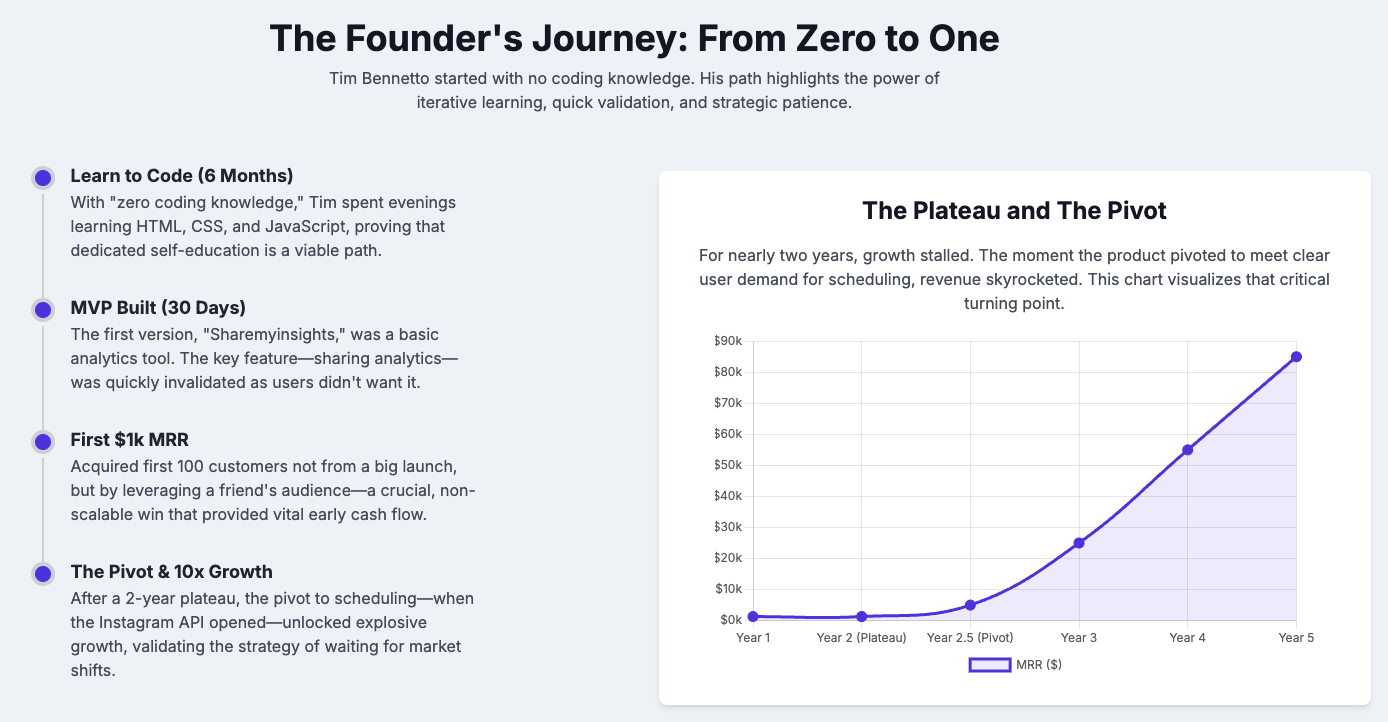
- Constraint-Driven Learning: Founder Tim Bennetto started with zero coding knowledge and no funding, so every learning and build decision was shaped by maximizing speed and personal leverage.
- Borrowed Audience for Traction: Rather than waiting on organic growth, Pallyy’s earliest users came via a redirected audience from a friend’s existing user base—solving the cold start problem creatively and cheaply.
- Niche Depth Before Horizontal Breadth: While the “all-in-one” vision was attractive, Tim focused obsessively on a single pain point (Instagram analytics and, later, scheduling). Only once product-market fit was real did he expand features and integrations.
- Relentless User-Feedback Loops: Early pivots, from analytics to scheduling, were dictated directly by user demand and pain, not pre-planned roadmaps.
- SEO and Content Leverage: After initial organic growth slowed, the flywheel was reset through a deep commitment to SEO-driven inbound—hiring (then scaling) writers and prioritizing affiliate partnerships.
- Ignore Startup “Rules”: Tim didn’t fundraise, didn’t overbuild, and didn’t obsess over launch hype. He leaned into direct outreach, price experimentation, and pragmatic marketing.
Key Early-Leverage Decisions
- Learned just enough code to ship MVP quickly
- Used a borrowed audience to skip the early “zero-users” trap
- Chose Instagram as the initial niche, then went broader only once sticky
- Added a high-impact scheduling feature as soon as Instagram’s API opened, ahead of slower incumbents
- Invested in SEO and affiliates, abandoning low-yield paid ads
- Let pricing evolve with value, not just competitor anchoring
The Growth Flywheel: Step-by-Step
Pallyy’s path from zero to $1M ARR is defined by a clear sequence of leverage points—not random hustle.
| Flywheel Stage | Strategic Intent | Irreversible Gain |
|---|---|---|
| Skill Acquisition | Reduce development cost, increase future autonomy | Ability to move fast and solo |
| MVP Build | Test market with narrow, shippable feature | Real users, data, proof of concept |
| Borrowed Audience Growth | Solve cold start, seed initial revenue | Early cash flow, proof for future pivots |
| 1st Pivot: Scheduling Feature | Respond to user demand; exploit new Instagram API window | Sales doubled, churn dropped |
| Niche SEO + Content Acquisition | Long-tail, compounding inbound; sustainable marketing | Majority of growth, scalable channel |
| Affiliate Program Layer | Expand reach via trusted 3rd parties | 22% of total MRR |
| Pricing Optimization | Test value capture, maximize ARPU | $10K+ MRR boost in a month |
| Niche Expansion & Feature Depth | Broaden market, increase switching costs | Cross-platform stickiness, agency appeal |
Strategic Leverage & Business Model
Pallyy is a case masterclass in founder leverage:
- Single-Person Automation: Solo development, automated onboarding, and AI tools for content meant minimal operational complexity at any scale.
- Channel Leverage: SEO and affiliates provided compounding, low-input traffic—SEO alone drove 90%+ of all signups.
- No Bloat: No team, no office, no VC reporting, no technical debt from overbuilding. Cash-flow positive from the start.
- Simple, Scalable Pricing: Two primary plans—Pay As You Go ($25/month per brand) and Unlimited ($199/month)—plus a generous Free tier for top-of-funnel volume. Expansion revenue comes from add-ons (users, brands), not high-effort upselling.
| Plan Name | Price | Key Inclusions | Target User |
|---|---|---|---|
| Free | $0 | 1 social set, 15 scheduled posts/month, basic analytics | Individuals, small biz |
| Pay As You Go | $25+/mo | Unlimited posts, advanced analytics, collab, approval workflows | Freelancers, small agencies |
| Unlimited | $199/mo | Unlimited everything, all features included | Agencies, large teams |
Retention is driven by feature depth (especially for Instagram/visual brands), continuous value delivery, and a focus on agency workflows. MRR has grown from $1K to $85K, with 24,000+ users and 700 paying customers.
Can You Replicate This Today?
Building Pallyy’s core thesis in 2025 is objectively easier and faster—if you exploit new tools and focus your execution:
- AI Code Generation & No-Code: Solo founders can ship MVPs in days, not months, thanks to platforms like Bubble, Webflow, and AI copilots.
- AI Content & SEO: Automated writing, image generation, and AI-powered SEO tools compress content scale from weeks to hours.
- API Integrations: Zapier, Make, and iPaaS tools accelerate integrations, lowering the technical barrier.
- Bottlenecks That Remain: Distribution is where most solo SaaS still stall. Borrowing or acquiring a relevant audience is still the best shortcut; pure virality or paid ads are unreliable bootstrapped channels. If starting from scratch today:
- Go “AI-native” from day one—text, images, UX, and analytics powered by LLMs, making the platform inherently dynamic.
- Use no-code for the MVP, focusing on rapid feedback over polish.
- Identify a real niche pain point (as Pallyy did with Instagram) and serve it with relentless depth before expanding.
- Secure initial users via borrowed/leveraged audiences, not hope.
- Layer SEO and affiliate as the main compounding channels.
Takeaways: How to Think Like This Founder
- Constraint is leverage: Let technical, budget, and time limits dictate smart decision making. Resource constraints are feature, not bug, for solo founders.
- Don’t wait for product perfection: Move rapidly to market and let real user pain guide iteration and pivots.
- Sequence > vision: Nail a single urgent pain point first, then broaden only once a wedge is established.
- Play long, compounding channels: Invest early in SEO and partnerships. Inbound and third-party channels have non-linear returns.
- Leverage AI and automation now: What took months in 2019 can be built in weeks with today’s toolstack—if you intentionally redesign the workflow.
- Your first traction is most likely borrowed: Reach, partner, or buy your way into an audience. Don’t build distribution from scratch if you can shortcut it. Part of the 100 Days, 100 Solo Startups series.