
Field Note / c-27
The Future of Work — AI Agents as Digital Colleagues
IDC predicts that by the end of 2026, 40% of G2000 companies will have roles involving direct interaction with AI...
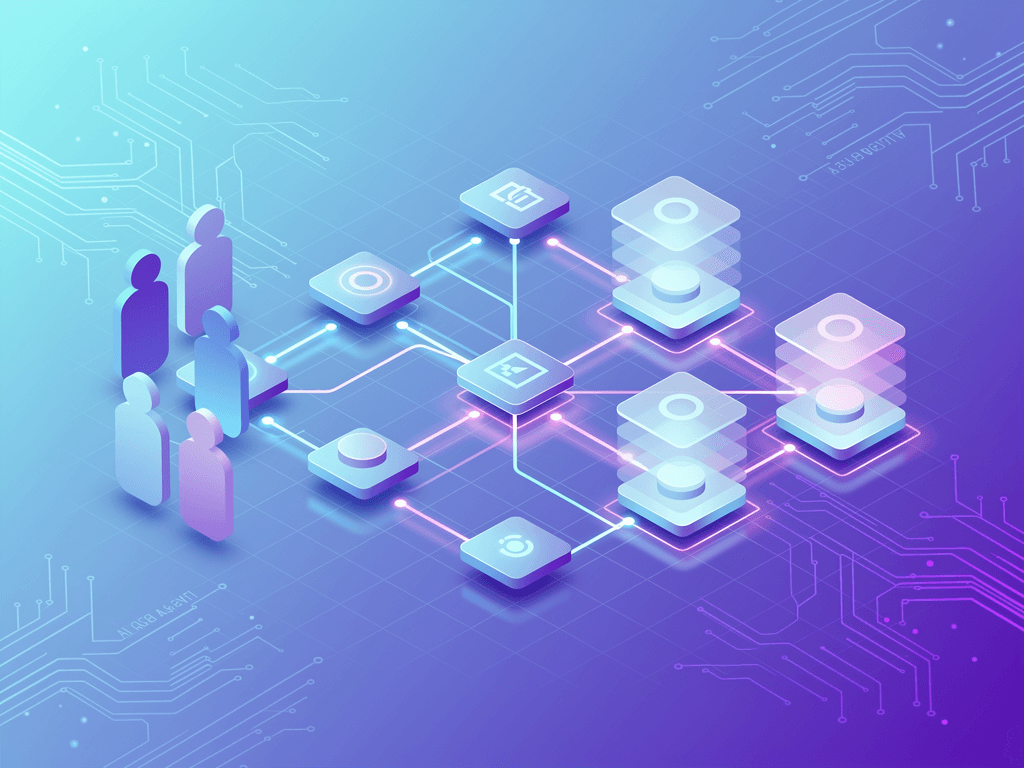
The Future of Work — AI Agents as Digital Colleagues
IDC predicts that by the end of 2026, 40% of G2000 companies will have roles involving direct interaction with AI systems. Not "using AI tools" — that's already above 80% — but AI as a formal workflow node with defined inputs, outputs, and accountability.
Companies like Microsoft, Cisco, and Salesforce are already rolling out the "Agent-as-teammate" concept internally. This isn't marketing — it's actual organizational restructuring: AI Agents appearing on project team rosters with a "reporting to" (supervising human), SLAs (service level agreements), and regular "performance reviews" (performance monitoring).
This isn't science fiction. This is happening right now.
I personally run a team of 6 Agents supporting three business lines. From the perspective of someone managing an AI team solo, I have some real-world observations and predictions about "the future of work." This article shares my analysis of organizational restructuring, new collaboration models, and the impact on the job market.
Three Structural Shifts Already Underway
Shift 1: From "Tool User" to "Agent Manager"
The traditional work relationship goes: people use tools to complete tasks. Excel doesn't decide what to do on its own. Photoshop doesn't pick its own filters. Tools are passive.
AI Agents change this relationship. Agents can autonomously execute multi-step tasks, make context-dependent judgments, and collaborate with other Agents. Your relationship with an Agent is closer to "manager and executor" than "user and tool."
This means a new core competency is becoming essential: Agent management — defining task boundaries, designing oversight mechanisms, evaluating Agent output quality, and handling Agent failures.
My day-to-day work managing 6 Agents feels more like managing a remote team: I scan each Agent's output daily, handle exceptions, adjust priorities, and occasionally optimize prompts (the equivalent of "giving feedback"). The difference from managing a human team: Agents don't get emotional, don't need motivation, don't take days off — but they also won't tell you "this direction might be problematic." You have to figure that out yourself.
Shift 2: From "Headcount" to "Capability Units"
Traditional organizational structures are designed around people: how many headcount a department has, what each person is responsible for. The addition of AI Agents is shifting how organizations think: no longer asking "how many people do I need," but "what capabilities do I need."
Some capabilities are provided by humans (strategic thinking, client relationships, creative judgment), some by Agents (data processing, report generation, process execution), and some are delivered through human + Agent collaboration (analysis, content creation, code development).
I've seen a B2B SaaS company restructure their customer service team like this: originally 15 people handling all tickets. After restructuring: 6 people + 3 Agents.
| Role | Type | Responsibilities |
|---|---|---|
| CS Manager | Human | Team management + escalation handling + Agent oversight |
| Senior CS x 3 | Human | Complex issues + VIP clients + Agent training |
| CS Specialist x 2 | Human | Exceptions Agents can't handle + QA spot checks |
| Triage Agent | AI | Automatic ticket classification and prioritization |
| Response Agent | AI | Automated replies to common questions |
| Analytics Agent | AI | Weekly CS data analysis and trend reports |
Headcount dropped from 15 to 6, but processing capacity actually increased by 40%. The key point: the work these 6 people do is completely different from before. They no longer spend time on repetitive replies but focus on complex issues, customer relationships, and Agent training — more valuable work and more fulfilling too.
Shift 3: The Rise of the "Agentic Manager"
Managing AI Agents and managing humans require different skill sets.
Core skills for managing humans: communication, motivation, conflict resolution, career development guidance.
Core skills for managing Agents: precision in task definition, designing output quality evaluation criteria, systems thinking (understanding dependencies between Agents), and judgment in handling exceptions.
A new role is emerging: the Agentic Manager — someone who manages Agents, or who manages hybrid teams of humans and Agents together.
Stanford's Future of Work research project is systematically studying the definition and skill requirements of this role. Their preliminary findings align with my experience in practice: Agentic Managers need both technical understanding (you don't necessarily need to write code, but you must understand an Agent's capability boundaries) and managerial judgment (knowing when to trust Agent output and when to intervene).
Four Models of Human-AI Collaboration
Based on task characteristics, I categorize human-Agent collaboration into four models:
Model 1: Agent-Led, Human-Supervised
The Agent independently completes 80%+ of the work; the human does final review and exception handling.
Suitable for: report generation, data organization, FAQ responses, document formatting.
My Report Agent follows this model. The Agent produces the full report; I review it for 10 minutes.
Model 2: Human-Led, Agent-Assisted
The human makes core decisions and does the creative work; the Agent provides information support and execution assistance.
Suitable for: solution design, strategy planning, content creation, complex negotiations.
This is how I write articles. I decide what to write and how to write it; the Research Agent gathers data for me, and the Content Agent adapts content for different platforms.
Model 3: Alternating Relay
Humans and Agents take turns playing the lead role in a workflow. For example: Agent does initial analysis -> human makes judgment and decision -> Agent executes the decision -> human reviews results.
Suitable for: sales processes (Agent screens leads -> human negotiates -> Agent follows up -> human closes), product development (Agent analyzes user research -> human defines requirements -> Agent writes code -> human reviews).
Model 4: Parallel Collaboration
Humans and Agents work simultaneously on the same task, each responsible for different aspects.
Suitable for: code development (human writes core logic, Agent writes tests and documentation), market analysis (human makes qualitative judgments, Agent runs quantitative calculations).
# Framework for selecting collaboration models
def select_collaboration_mode(task: dict) -> str:
    """Select the best human-AI collaboration model based on task characteristics"""

    creativity = task.get("creativity_required", 0)  # 0-10
    domain_knowledge = task.get("domain_knowledge", 0)  # 0-10
    repetitiveness = task.get("repetitiveness", 0)  # 0-10
    stakes = task.get("stakes", 0)  # 0-10, cost of failure

    if repetitiveness > 7 and stakes < 4:
        return "Agent-led, human-supervised"
    elif creativity > 7 or domain_knowledge > 7:
        return "Human-led, Agent-assisted"
    elif stakes > 6:
        return "Alternating relay"  # High-stakes tasks need multiple human checkpoints
    else:
        return "Parallel collaboration"
Impact on the Job Market
To be honest, this part is sensitive. But if I'm writing this article, I can't shy away from it.
Short-Term (2026-2028): Job Restructuring, Not Mass Elimination
Current AI Agent capabilities primarily replace "information processing" work: data entry, report writing, email replies, form processing. These jobs won't disappear entirely, but the number of people needed to do them will drop significantly.
At the same time, new roles are emerging: Agent operations engineers, prompt engineers, AI project managers, Agent trainers (responsible for continuously improving Agents with new data and feedback).
Net effect: My assessment is that total employment won't decline sharply in the short term, but the job mix will shift rapidly. The pace of restructuring is faster than many expect — not three to five years, but one to two.
Mid-Term (2028-2032): The Efficiency Gap Widens
The productivity gap between individuals and companies that use AI Agents well and those that don't will widen to 3-5x. This isn't speculation — I'm already seeing it in microcosm in my own consulting business: what I accomplish solo would traditionally require 3-4 people.
This means: people who can work with Agents won't lose their jobs — their market value will rise because one person can produce the output of three. People who can't work with Agents will face mounting pressure — not because AI directly replaces them, but because they're at a competitive disadvantage against peers who use AI.
My Personal Take
AI Agents won't "replace" human work. They'll redefine what "work" means.
Over the past 200 years, every major technological shift — the steam engine, electricity, computers, the internet — followed the same pattern: old jobs declined, new jobs emerged, and overall productivity and living standards rose. AI Agents will follow the same trajectory.
But the transition is painful. There's a time lag between old jobs disappearing and new ones materializing. Policy, education, and businesses all need to keep up.
Personal Strategies for Navigating the Shift
Enough about the macro picture. Here's what you can actually do:
Strategy 1: Learn to Manage Agents
Regardless of your industry, learning to define tasks, design prompts, evaluate AI output, and handle AI errors — these will become foundational skills, like Excel and PowerPoint are today.
You don't need to learn programming (though it helps), but you do need to understand how Agents work and where their limits are. Many members of the Solo Unicorn Club don't have technical backgrounds, but through 3-4 weeks of systematic learning, they're already building their own Agents with the Claude API and simple no-code tools.
Strategy 2: Invest in Uniquely Human Capabilities
Things Agents do poorly: building trust, handling highly ambiguous problems, making creative connections across domains, and making judgment calls with incomplete information.
The value of these capabilities will increase. If your current work is 70% information processing and 30% judgment and relationships, find ways to flip that ratio. Let Agents handle the 70% so you can focus on the 30%.
Strategy 3: Become the "Human + Agent" Package
The most competitive people aren't "pure human experts" or "AI-only operators" — they're the combination of "human judgment + Agent execution power."
The most successful independent consultants I know, without exception, are using AI to amplify their capabilities. They're not being replaced by AI — they're using AI to make themselves scarcer, because one person can now deliver what used to require a small team.
Three Core Takeaways
First, AI Agents are evolving from "tools" into "colleagues." This isn't a metaphor — it's a concrete organizational change. Agents are gaining formal job descriptions, SLAs, and performance evaluations. What you need to learn isn't just "how to use AI tools," but "how to collaborate with AI colleagues."
Second, "Agentic Manager" is an emerging high-value role. People who can manage both human teams and Agent teams are extremely scarce in the market. This role requires a combination of technical understanding and managerial judgment, and there's no established training pipeline yet. Early movers have an enormous first-mover advantage.
Third, the efficiency gap is widening fast. The productivity difference between those who use Agents well and those who don't will grow from 1.5x to 3-5x within 2-3 years. This isn't a threat — it's an opportunity, if you start learning and practicing now.
How long do you think it will take before Agents become a standard work partner in your industry or role?