Field Note / e-41
MuleRun's AI Native Message at NY Tech Week: What One-Person Companies Should Learn
MuleRun's June 3 New York Tech Week event framed AI Native organizations as a practical path from one-person companies to SMBs and enterprises.
MuleRun's AI Native Message at NY Tech Week: What One-Person Companies Should Learn
AI Summary
On June 4, 2026, MuleRun announced through PRNewswire that it hosted "Go AI Native with MuleRun" during New York Tech Week on June 3. The event focused on scaled AI agent adoption, AI Native organizations, and the path from one-person companies to SMBs and large enterprises. MuleRun also said it had surpassed one million users in eight months.
For solo founders, the useful takeaway is not a single feature. It is an operating model: an AI Native company does not simply "hire fewer people." It treats AI as a trainable collaborator embedded in workflows.
Key Facts
| Fact | Why it matters |
|---|---|
| MuleRun's event took place on June 3, 2026 during New York Tech Week | It is part of this week's live New York AI startup ecosystem |
| The release explicitly mentioned one-person companies, SMBs, and large enterprises | The AI Native narrative now includes solo founders |
| MuleRun said it surpassed one million users in eight months | Personal AI workforce products are still attracting rapid adoption |
| The event framed AI as an apprentice to cultivate, not a replacement for people | This is closer to real operations than full-automation fantasy |
What AI Native Means For One-Person Companies
Many people define AI Native as "using AI for everything." That is too vague.
A better definition: from day one, the business workflow assumes that humans and AI will work together. You do not start with a manual process and later bolt on automation. You also do not throw every task at a model. You split judgment, execution, feedback, and learning into separate parts.
One-person companies are unusually well suited for this because they have less legacy process. You do not need to convince ten departments to change their habits. You can simply ask:
- Where is the judgment point in this task?
- Which steps are repetitive execution?
- What material does the AI apprentice need to do the job well?
- How will I correct mistakes?
- Will those corrections become memory for the next run?
Those questions matter more than the specific AI tool you choose.
Three Startup Lessons From MuleRun's Signal
1. A super individual is not one person working harder
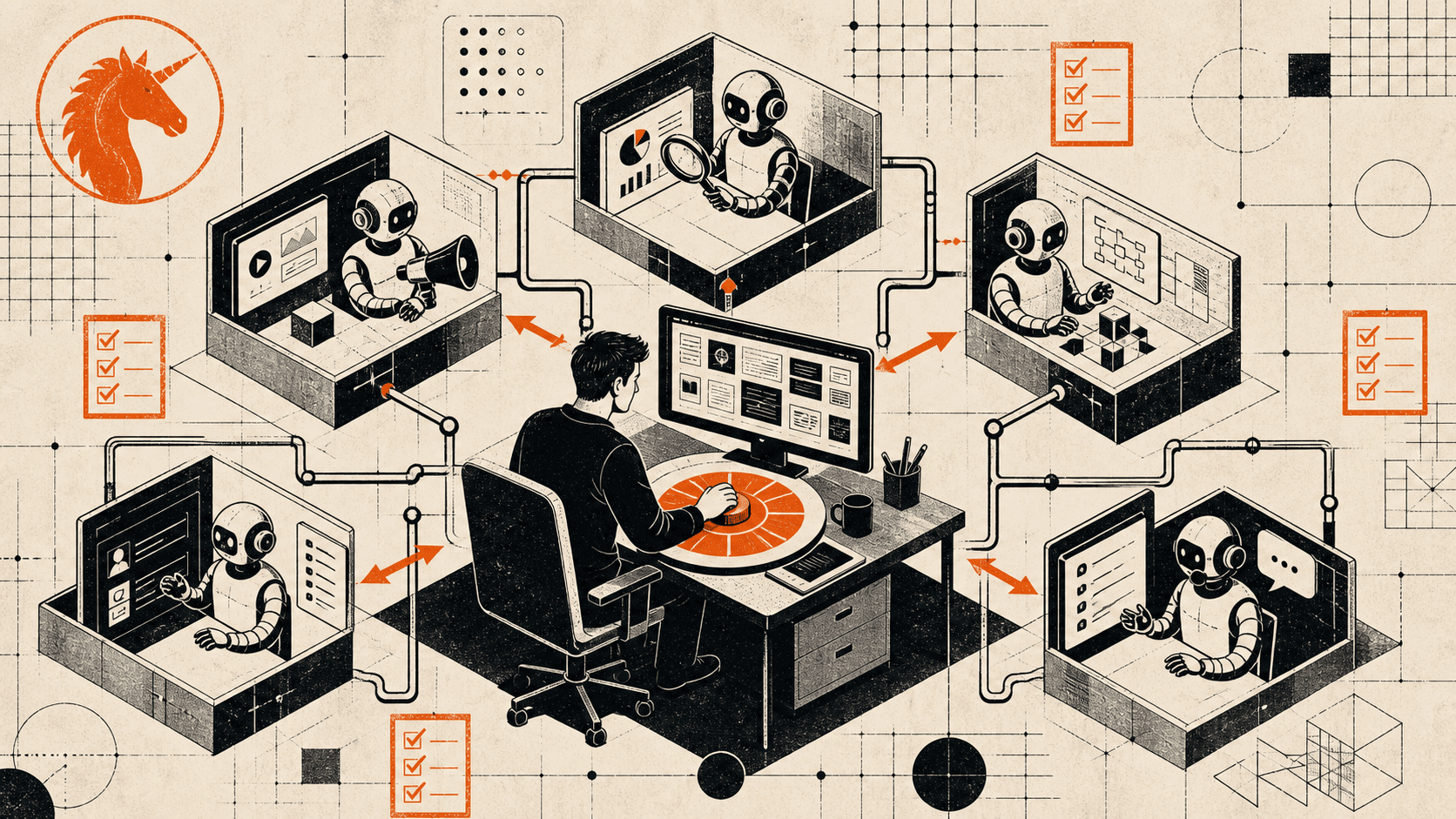
A super individual is one person managing a set of AI apprentices. Each apprentice needs training material, sample tasks, quality standards, and feedback. The leverage comes from repeatedly improving the same workflow, not from one perfect prompt.
2. Frontline operators become AI builders
The PRNewswire release emphasized that companies should not rely only on AI engineers. Frontline employees can become builders of their own workflows. In a one-person company, the frontline operator is you. You understand the customer, sales motion, delivery process, product, and operations, so you are the best person to train the agent.
3. Judgment is the moat of AI Native work
MuleRun's event emphasized human judgment. For solo founders, that is the whole point. AI can multiply your speed, but it cannot replace taste, commercial judgment, or customer intimacy. AI Native work does not remove the human. It puts human judgment in a higher-leverage position.
Sources And Timeline
| Date | Source | Information used |
|---|---|---|
| 2026-06-04 | PRNewswire: Go AI Native with MuleRun Lights Up New York Tech Week | June 3 event, AI Native theme, one-person company framing, one million users in eight months, and AI apprentice positioning |
| 2026-06-01 to 2026-06-07 | Official New York Tech Week Schedule | New York Tech Week timing and event context |
Bottom Line
AI Native is not a tool list. It is an operating model. For one-person companies, the best starting point is not a fully automated company. It is a set of reliable AI apprentices: each one owns a clear workflow, each output gets feedback, and each correction becomes system memory.