
Field Note / e-33
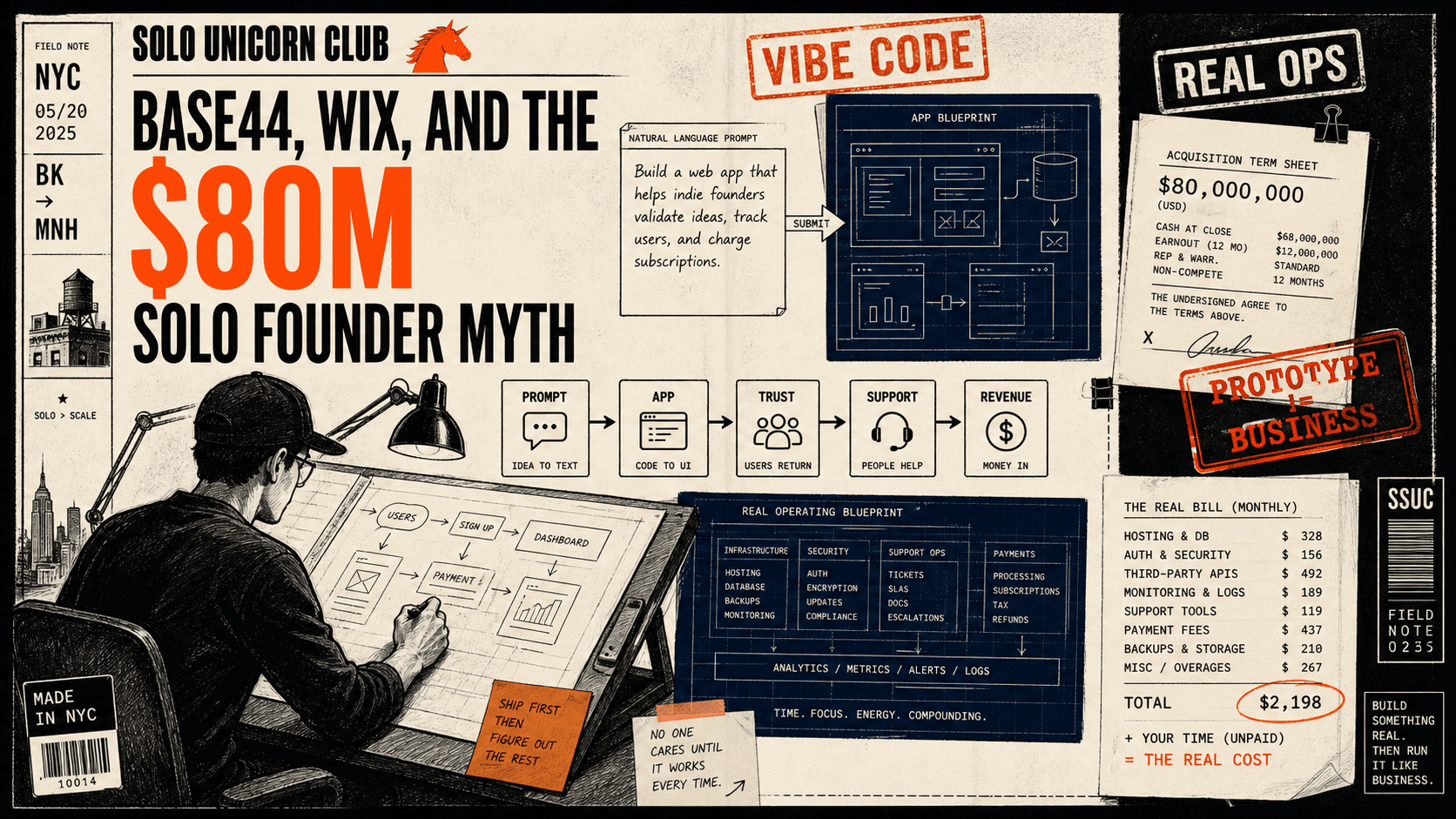
The $80M Solo Founder Myth
When Wix announced it was acquiring Base44, every solo founder group chat had the same reaction: Can one person really...
The $80M Solo Founder Myth
When Wix announced it was acquiring Base44, every solo founder group chat had the same reaction:
Can one person really build an AI company worth tens of millions of dollars?
That is the headline version. It is exciting, useful for engagement, and slightly dangerous.
The better question is not "Can I copy Base44?"
The better question is:
What did Base44 reveal about the new shape of software creation, and what should a one-person AI company actually do with that information?
This article is not a hype piece. It is a field note for solo AI founders, vibe coders, indie hackers, and one-person company operators trying to understand what the Base44 moment really means.
The Signal
In June 2025, Wix announced that it would acquire Base44, an AI platform for building full-function custom software through natural language. Wix described Base44 as a fast-growing platform that could generate applications with databases, authentication, storage, analytics, and deployment.
The reported initial consideration was roughly $80 million.
That matters because Base44 was not just another code assistant. It represented a larger shift:
- software creation is moving from code-first to intent-first
- non-engineers can now express product requirements directly
- AI app builders are collapsing the distance between idea and prototype
- end-to-end workflows matter more than isolated code generation
- the market is rewarding products that remove operational friction, not just products that produce pretty demos
For one-person companies, this is a big deal.
But it does not mean every solo founder should build a general-purpose AI app builder.
That is the lazy interpretation.
Why Base44 Worked as a Signal
Base44 pointed at three things the market wants.
1. People Do Not Want Code. They Want Working Software.
Most customers do not wake up wishing they had more React components.
They want:
- a customer portal
- an inventory tracker
- an internal approval tool
- a lead scoring system
- a booking workflow
- a reporting dashboard
- a CRM extension
- a lightweight marketplace
Traditional no-code tools helped, but they still required users to understand data models, workflows, integrations, and UI logic.
AI app builders changed the interface. Instead of assembling software visually, users describe the outcome.
That is a huge market expansion.
The buyer is no longer only the developer. The buyer is any operator with a workflow problem.
2. The Full Stack Matters More Than the Demo
The easiest AI demo is a beautiful screen.
The hard part is:
- database
- authentication
- permissions
- deployment
- payments
- file storage
- analytics
- error handling
- security
- maintenance
That is where many vibe-coded products break.
The Base44 lesson is not "AI can generate apps." We already knew that.
The lesson is: if you can make the boring parts feel invisible, you create real business value.
One-person founders should pay attention to that. The boring parts are where customers pay.
3. The Best Wedge Is a Painful Workflow
General-purpose platforms are seductive. They also require massive distribution, trust, infrastructure, support, and ecosystem depth.
A solo founder usually has a better path:
Pick one painful workflow in one specific market.
Examples:
- an AI quote builder for jewelry wholesalers
- an onboarding portal for boutique consulting firms
- a client reporting system for marketing agencies
- an intake and document review workflow for immigration lawyers
- an inventory reconciliation tool for small retailers
- a sponsor management system for local events
Do not start with "I am building an AI app builder."
Start with "I am solving this workflow so well that the customer does not care how it was built."
The Hidden Costs of a One-Person AI Platform
The myth says: one person plus AI equals infinite leverage.
The operating reality is more complicated.
Cost 1: Quality Control
AI-generated apps can look finished before they are safe.
A generated app may:
- expose private data
- mishandle permissions
- skip validation
- create fragile database schemas
- break when users behave unexpectedly
- lack audit logs
- fail silently
If you sell software to real customers, you own those failures.
The founder's job becomes quality control, not just generation.
Cost 2: Support
Every successful software product creates support load.
If customers use an AI-generated workflow to run real business operations, they will ask:
- Why did this fail?
- Can you customize this?
- Is my data safe?
- Can I export it?
- Can this integrate with my existing tools?
- What happens if your service goes down?
That is not a prompt problem. That is an operations problem.
Cost 3: Trust
People will test AI-generated software for fun. They will only run business processes on it if they trust it.
Trust comes from:
- clear data handling
- reliable uptime
- professional documentation
- visible support
- thoughtful onboarding
- industry understanding
- credible security posture
Solo founders underestimate trust because prototypes are cheap. Production is where trust gets expensive.
Cost 4: Platform Risk
Many AI app builders depend on underlying models, hosting providers, payment systems, and infrastructure APIs.
Your cost structure can change quickly. Your model output quality can change. A platform you rely on can change policy. A third-party service can break.
This does not mean do not build. It means build with a system, not vibes alone.
What Solo Founders Should Actually Do
Here is the practical playbook.
Step 1: Pick an Industry You Can Actually Access
The best solo company ideas often come from unfair access.
If you are in New York, you might have access to finance, luxury, fashion, media, legal, real estate, restaurants, healthcare, education, or immigrant founder communities.
Do not chase generic AI ideas. Chase conversations you can actually have.
The best question is:
Which workflow do smart people around me still run with spreadsheets, email, screenshots, and manual follow-up?
That is your wedge.
Step 2: Build the First Version Fast
Use whatever gets you to a working prototype:
- v0
- Lovable
- Bolt
- Replit
- Cursor
- Claude Code
- Codex
- Supabase
- Airtable
- Retool
- n8n
The tool matters less than the customer reaction.
If the customer says, "This is cool," keep learning.
If the customer says, "Can I use this next week?" you may have something.
Step 3: Productize the Boring Parts
Once a workflow works, stop adding features and start making it reliable.
Focus on:
- onboarding
- permissions
- error states
- exports
- billing
- notifications
- support
- documentation
- analytics
- security basics
This is where a prototype becomes a business.
Step 4: Charge Before You Generalize
Do not build a platform too early.
Charge for a specific workflow first. A customer paying for a narrow product teaches you more than 1,000 people playing with a free general-purpose tool.
Pricing options:
- setup fee plus monthly subscription
- per-workflow pricing
- per-seat pricing
- usage-based pricing with caps
- outcome-based pricing for high-value workflows
The right price depends on the business pain, not the AI model cost.
Step 5: Turn Delivery Into a Template
The solo founder advantage is speed. The weakness is capacity.
Every customer delivery should become:
- a reusable prompt
- a code template
- a workflow checklist
- an onboarding doc
- a test plan
- a support macro
- a case study
That is how a one-person company compounds.
The Real Base44 Lesson
Base44's acquisition is not permission to build random AI apps.
It is proof that software creation is moving closer to the person who understands the workflow.
That is good news for solo founders.
If you understand an industry deeply, you no longer need a full engineering team to test the first version of a product. You can move from conversation to prototype quickly. You can ship tools for niches that would have been too small for venture-backed teams.
But the bar is also rising.
Everyone can generate a demo. Fewer people can turn a demo into a reliable business.
That is where the solo unicorn opportunity lives.
FAQ: Base44 and One-Person AI Companies
What should solo founders learn from Base44?
The main lesson is that natural language software creation is becoming real, but the durable value is in end-to-end workflows, reliability, trust, and industry-specific use cases.
Should I build a general AI app builder?
Probably not as a first move. Most solo founders are better off building a focused workflow product for a specific customer segment they can access directly.
What is vibe coding?
Vibe coding is using AI coding tools to build software by describing intent in natural language and iterating quickly. It is powerful for prototyping, but production software still needs testing, security, architecture, and support.
Can a one-person AI company get acquired?
Yes, but acquisition depends on growth, strategic value, product reliability, distribution, defensibility, and transferability. Do not build only for the exit headline.
One Sentence Summary
The Base44 moment proves that one person can build further than ever, but the real opportunity is not a flashy demo. It is a narrow workflow, a real customer, and a product that survives contact with business reality.
Source signal: Wix's Base44 acquisition announcement.